

When numbness, tingling, or weakness changes how your feet meet the floor, an ordinary turn or step can demand much more attention than it once did. That uncertainty can make you move less, but avoiding movement entirely may also allow leg strength and confidence to decline. A safer approach is to practice simple, controlled movements in a protected setting.
Support your daily nerve-health routine with Neuro-Blast Subscribe & Save.
This guide explains balance exercises for neuropathy with a safety-first focus for adults who want to feel steadier during daily activities. Exercise may support balance, strength, coordination, and confidence, but it does not treat neuropathy or eliminate fall risk. Always use sturdy support, ask a capable spotter to stay nearby when needed. And talk with a clinician or physical therapist before starting if you have significant numbness, weakness, dizziness, recent falls, or another medical concern.
Why Can Neuropathy Change Your Balance?
Neuropathy can affect balance when reduced sensation, weakness, or slower nerve signals make it harder to sense the floor and correct a misstep. Balance also depends on vision, the inner ears, muscles, and joints, so each person's safest exercise plan should reflect their specific symptoms and abilities.
The Mayo Clinic lists numbness, muscle weakness, and loss of balance among possible symptoms of peripheral neuropathy. Your experience may be different from someone else's, depending on which nerves are affected and what caused the condition. That is why a one-size-fits-all exercise plan is rarely appropriate.
Reduced sensation changes the feedback loop
If the soles of your feet cannot clearly sense pressure or position, your brain receives less information about your base of support. You may compensate by watching the ground, widening your stance, or taking shorter steps. These strategies can feel reassuring, but they do not remove the need to improve strength and practice controlled movement.
Strength and reaction time matter too
Your ankles, calves, thighs, hips, and trunk help keep you upright. They also help you recover when your weight shifts unexpectedly. Balance practice often works best when it includes gentle strengthening and repeated practice of movements used in real life. Such as standing from a chair, shifting weight, and stepping in different directions.
Falls deserve serious attention. The CDC reports that falls are the leading cause of injury for adults age 65 and older. While exercise cannot guarantee that a fall will not happen, the CDC also notes that exercises that improve balance and leg strength can lower an older adult's chance of falling. For someone with neuropathy, the safest program is one matched to current ability by a qualified clinician.
How Do You Set Up for Safer Balance Practice?
Set up beside a fixed counter or other sturdy support, clear the floor, use bright lighting, keep your eyes open, and wear supportive footwear. A capable spotter should stay close when needed. If an exercise feels frightening or uncontrolled, stop rather than testing your limits alone.
Check with a clinician before you begin
Get professional guidance before starting if you have fallen recently, need a cane or walker, cannot stand without help. Have an open foot wound, or experience severe weakness, faintness, chest pain, new dizziness, or rapidly changing symptoms. Stop exercising and seek appropriate care if any concerning symptom appears. Sudden weakness, confusion, trouble speaking, or a sudden severe headache requires urgent medical attention.
Create a safer practice area
- Practice beside a fixed kitchen counter, heavy table, or other sturdy support that will not slide or tip.
- Clear rugs, cords, pets, clutter, and wet spots from the area.
- Use bright, even lighting and keep your eyes open. Never practice balance exercises with your eyes closed.
- Wear well-fitting, supportive footwear unless your clinician has specifically recommended otherwise.
- Keep a stable chair nearby for seated rest, but do not rely on a lightweight chair as your only support.
- Ask a capable spotter to stand close enough to help, especially during a new exercise.
- Keep your phone or alert device within reach.
Inspect your feet before and after activity if sensation is reduced. Look for redness, blisters, cuts, swelling, or pressure marks that you may not feel. Ask a clinician how to care for any concerning area before continuing. For more lower-limb comfort and home-safety ideas, see these home remedies for neuropathy in legs and feet.
Six Supported Balance Exercises to Practice
Six beginner-friendly options are seated ankle movements, supported sit-to-stands, supported weight shifts, supported marching, side steps, and heel raises. Begin with sturdy support and slow repetitions. Choose control over difficulty, rest before fatigue affects your form, and ask a clinician to tailor the routine.
1. Seated ankle and toe movements
Sit tall in a stable chair with both feet on the floor. Lift your toes while keeping your heels down, then lower them. Next, lift your heels while keeping the balls of your feet down. Finish by gently pointing and flexing one foot at a time. These movements warm up the lower legs without requiring you to stand. Try 8 to 10 slow repetitions if comfortable.
2. Supported sit-to-stand
Sit near the front of a firm chair that is against a wall. Place your feet about hip-width apart. Lean your chest slightly forward and stand using the armrests or sturdy counter as needed. Pause, then slowly sit back down. Begin with 3 to 5 repetitions. A higher seat may be appropriate if standing is difficult. Do not use a rolling chair.
3. Supported weight shifts
Stand facing a counter with both hands resting on it and feet comfortably apart. Keeping your body tall, slowly shift more weight toward your left foot without lifting either foot. Return to center, then shift right. Next, make small forward and backward shifts while keeping the whole movement controlled. Try 5 shifts in each direction.
4. Supported marching
Hold the counter with both hands. Lift one foot only an inch or two, place it down fully, and repeat on the other side. Keep your chest upright and avoid rushing. Start with 6 to 10 alternating steps. If you cannot lift a foot without swaying or gripping hard, practice weight shifts instead and ask a clinician about progression.
5. Supported side steps
Stand alongside a long counter so you can keep at least one hand on sturdy support. Step one foot a short distance to the side, then bring the other foot toward it without crossing your legs. Take 3 to 5 small steps in one direction, pause, and return. A spotter should stay close, and the path must be completely clear.
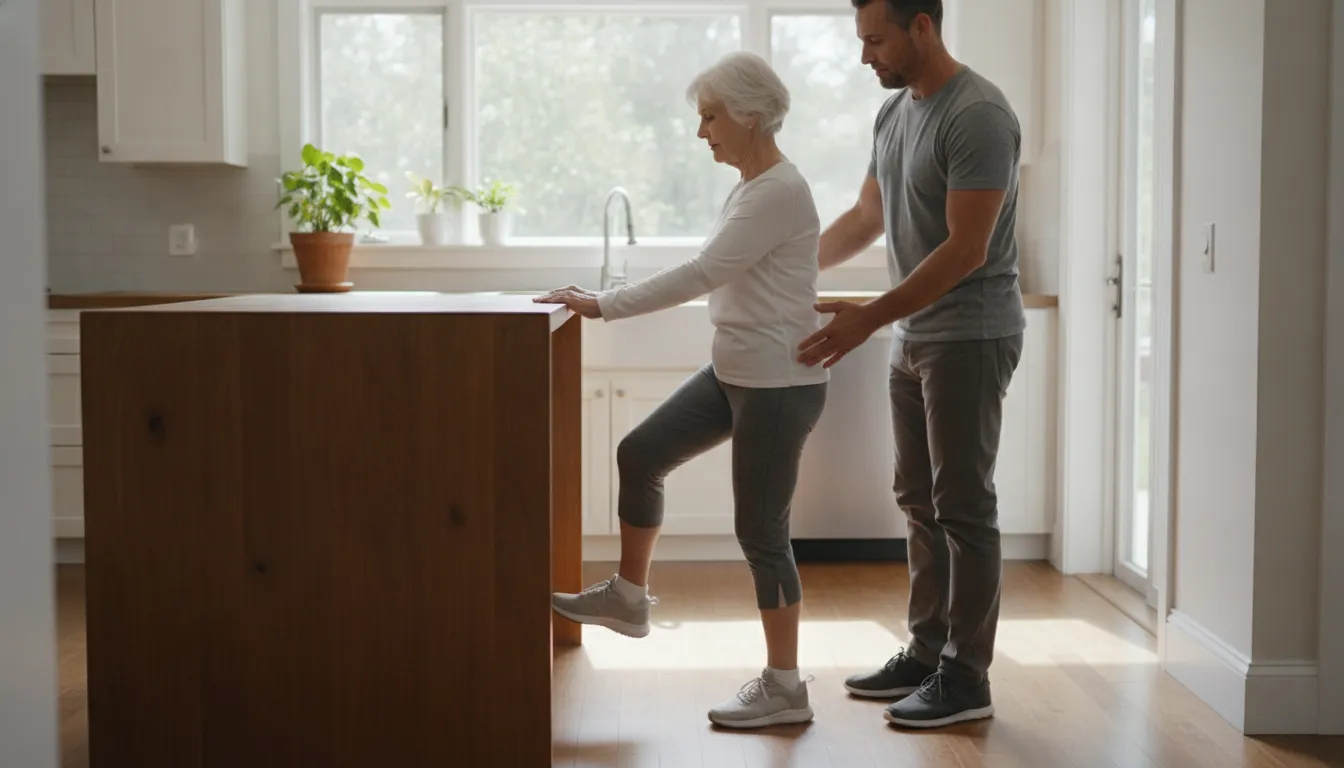
6. Supported heel raises
Facing the counter with both hands supported, slowly lift your heels so your weight moves toward the balls of your feet. Keep the movement small and controlled, then lower your heels gently. Begin with 5 repetitions. Skip this exercise if it causes foot pain, cramping, or unsafe sway. A clinician can offer a seated alternative.
Balance practice is only one part of a broader self-care approach. Explore additional ideas for gentle exercise for neuropathy, while remembering that lifestyle measures should complement, not replace, professional care.
See the complete Neuro-Blast system for daily and on-the-go nerve health support.
What Does a Safe 8-12 Minute Routine Include?
A short routine can combine a seated warm-up, sit-to-stands, weight shifts, supported marching, side steps, and a seated cool-down. Use sturdy support throughout, adjust every movement to your ability, and stop before fatigue. Skip any step that does not feel fully controlled that day.
- Minute 1: Set up and check in. Clear the area, position sturdy support, check your footwear, and notice how steady you feel today. If today feels worse than usual, choose seated movement or contact your clinician.
- Minutes 1-2: Warm up seated. Perform slow toe lifts, heel lifts, and ankle movements while seated in a stable chair.
- Minutes 2-3: Practice sit-to-stand. Complete 3 to 5 controlled repetitions using your hands and support as needed, then rest.
- Minutes 3-5: Shift your weight. At the counter, make small side-to-side and forward-backward shifts without lifting your feet.
- Minutes 5-7: March with support. Alternate small, slow foot lifts while keeping both hands near or on the counter.
- Minutes 7-9: Side step along the counter. Take a few short steps each way without crossing your feet. Skip this step if the movement is not fully controlled.
- Minutes 9-10: Add supported heel raises or repeat weight shifts. Choose the safer option for your ability that day.
- Minutes 10-12: Cool down seated. Sit, breathe slowly, repeat gentle ankle movements, and check how your feet and body feel.
You do not have to use every available minute. A shorter, controlled session is more useful than continuing when tired or unsteady. Record which movements felt comfortable and share changes with your physical therapist or clinician.
How to Progress Without Sacrificing Safety
Progress by changing only one variable at a time while a familiar movement remains controlled. You might add one or two repetitions before reducing hand support. Never progress by closing your eyes, standing on an unstable object, or moving away from sturdy support during unsupervised home practice.
Use the table below as a discussion guide with your clinician. Only move to a new level when the current level feels steady across several sessions and a professional agrees the change is appropriate.
| Practice level | Support and setting | Example activity | Sign to stay at this level |
|---|---|---|---|
| Seated foundation | Stable chair against a wall | Ankle movements, toe lifts, seated marching | You feel unsafe standing or cannot rise without substantial help |
| Two-hand support | Both hands on a fixed counter, spotter nearby | Weight shifts, small marches, heel raises | You grip hard, sway, or cannot control each repetition |
| Light two-hand support | Fingertips from both hands on counter, with clinician approval | Smaller weight shifts and slow marching | Your hands repeatedly press down or your feet shuffle |
| One-hand support | One hand on counter and spotter present, only when approved | Side steps or controlled marching | You lean, rush, or need the spotter to correct you |
| Functional practice | Clinician-selected environment and appropriate assistive device | Turns, obstacle awareness, or varied walking tasks | You have near-falls, new symptoms, or difficulty using your device |
Progress only one variable at a time. For example, add one or two repetitions while keeping the same support, rather than adding repetitions and reducing hand support together. A simple journal can help you notice whether sleep, medication timing, foot discomfort, or fatigue changes your stability.
Support Better Balance Throughout Your Day
Support better balance beyond exercise by reducing hazards, improving lighting, using prescribed assistive devices, and moving deliberately. Keep frequently used items within easy reach, pause after standing, and turn slowly. Ask a clinician or occupational therapist for a home review if you are concerned about falls.
Make everyday movement more deliberate
Pause after standing before you begin walking. Take turns slowly rather than pivoting quickly. Give yourself extra time when moving across different surfaces, such as from carpet to tile. If a cane or walker has been prescribed, use it as instructed rather than saving it only for difficult days. Have the fit and technique checked periodically.
Pair practice with whole-person care
Discuss changes in numbness, weakness, pain, vision, hearing, dizziness, and medication side effects with your healthcare team. Stay within the physical-activity plan they recommend, and ask whether strength, flexibility, walking, or aerobic activity should complement your balance work. A thoughtful daily nerve support routine can also help you organize questions and healthy habits without treating exercise as a cure.
Consistency can matter more than intensity, but consistency should never override safety. Some days may call for a shorter session or seated alternatives. Respecting those changes is not a setback; it is part of practicing responsibly.
Frequently Asked Questions About Balance Exercises for Neuropathy
What are the best balance exercises for neuropathy?
The best exercises are the ones matched to your current sensation, strength, and fall risk by a clinician or physical therapist. Common starting options include seated ankle movements, supported weight shifts, sit-to-stands, and supported marching. Exercise may support balance, but it does not treat neuropathy or eliminate fall risk.
Are balance exercises safe for someone with neuropathy?
They may be appropriate when carefully selected and performed with sturdy support, good lighting, proper footwear, and a spotter when needed. People with recent falls, severe numbness, wounds, dizziness, or significant weakness should get clinical guidance before beginning. Never practice with your eyes closed.
How often should I practice balance exercises?
Frequency should be set with your clinician. Many people benefit from brief, consistent practice that ends before fatigue affects form. Start with the duration and exercises a professional recommends, track your response, and report any increase in pain, numbness, weakness, dizziness, or instability.
Can balance training prevent every fall?
No. Balance and strengthening exercise may support stability and can be part of a fall-prevention plan, but no routine eliminates fall risk. Home safety, medication review, vision care, appropriate footwear, assistive devices, and clinician guidance may all be important parts of a broader plan.
Get Moving, Again With a Complete Nerve Health Support Routine
Safer movement begins with a plan you can trust: professional guidance, a protected practice area, and steady progress that respects how you feel today. Neuro-Blast is a doctor-created, dual-delivery system designed to support healthy nerve function, nerve comfort, and mobility alongside healthy daily habits. It does not treat neuropathy and is not a replacement for medical care or fall-prevention guidance.
Choose Neuro-Blast Subscribe & Save and Get Moving, Again.
These statements have not been evaluated by the Food and Drug Administration. This product is not intended to diagnose, treat, cure or prevent any disease.
