

It often starts as a strange feeling: a pebble in your shoe that isn't there, or a sock bunched under the ball of your foot. Over time it can turn into burning or electric pain that shoots into two toes. That pattern is the classic sign of Morton's neuroma, a common nerve cause of ball-of-foot pain.
Here's how it feels, how it's confirmed and what studies show for each treatment, from shoes to surgery.
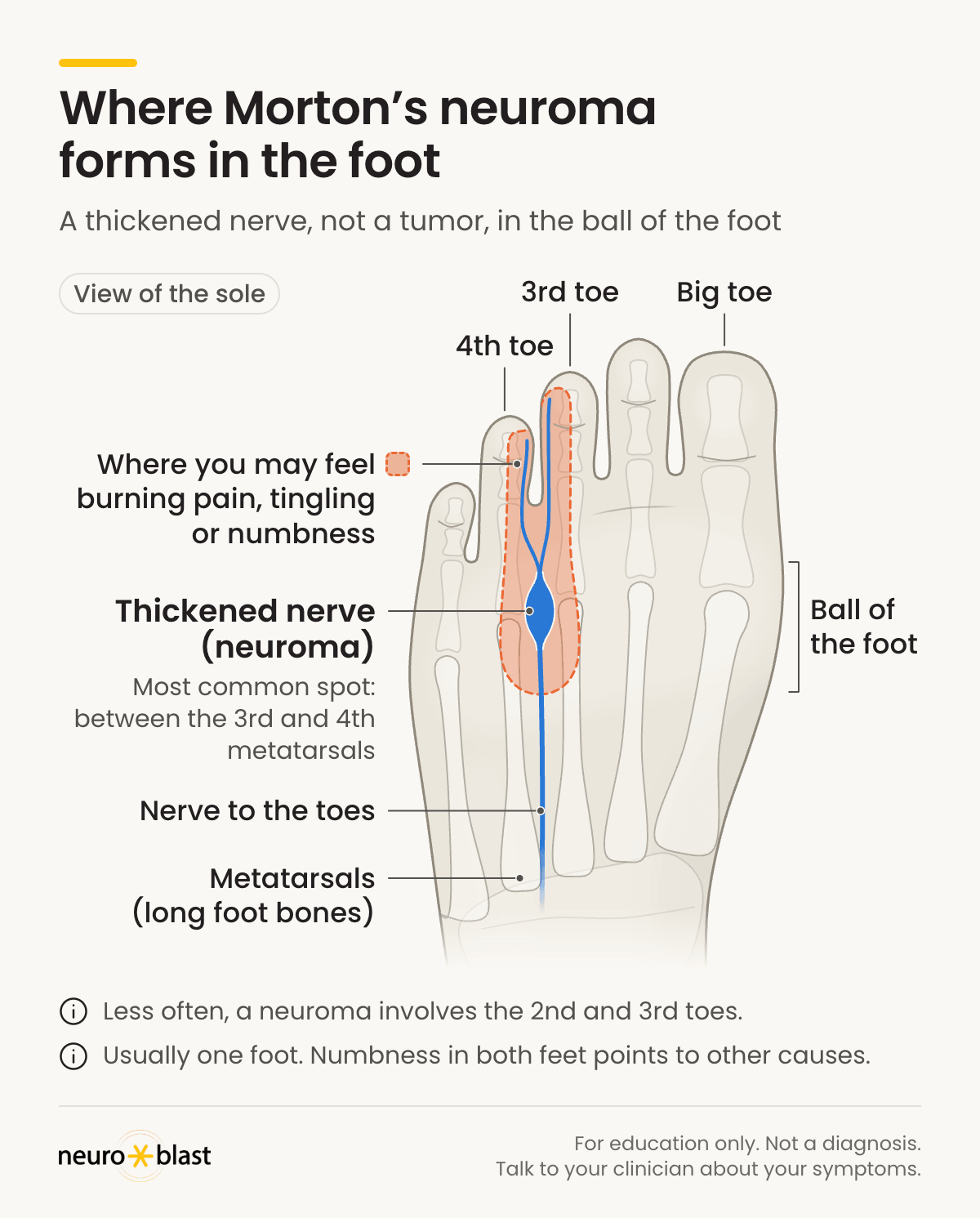
Morton's neuroma is a compressed, thickened nerve (not a tumor) in the ball of the foot, usually between the 3rd and 4th toes. It causes burning or sharp pain, a pebble-in-the-shoe feeling and sometimes numbness between those toes. Wider shoes and metatarsal pads come first. Injections, ablation or surgery are options if symptoms persist.
What is Morton's neuroma?
Small interdigital nerves run between the long foot bones (metatarsals) to your toes. Near the metatarsal heads, the "knuckles" at the ball of your foot, they pass under a tight ligament and can be squeezed. Repeated pressure causes fibrosis, a buildup of scar-like tissue around the nerve.
A neuroma most often forms between the 3rd and 4th metatarsals because that gap is narrower than the others. Less often it involves the 2nd and 3rd toes.
Women are affected 5 to 8 times more often than men, typically between ages 30 and 60.
How common is it? Cleveland Clinic says about 1 in 3 people have one at some point, while a 2024 systematic review cites about 4% of the general population. Imaging may explain part of the gap: in a small MRI study, 33% of patients scanned for other foot problems had a neuroma but no clinical signs of one.
Morton's neuroma symptoms
What does Morton's neuroma feel like?
- A feeling that you're standing on a pebble or lump, or walking on a stone or marble
- Burning, stabbing or tingling pain between the metatarsal heads, with electric sensations into two neighboring toes
- Pain that is worse in tight or high-heeled shoes and eases for a while when you take your shoes off or massage your foot
- Sometimes a clicking sensation in the ball of the foot
Not sure where yours sits? This guide to foot pain by location can help you describe it.
Numbness between toes
Numbness or pins and needles between two toes, usually the 3rd and 4th, is a recognized symptom, but it shows up in fewer than half of people with a neuroma.
The location is the clue. A neuroma affects one web space, usually in one foot. Numbness or burning in both feet that spreads upward from the toes fits a different set of neuropathy symptom patterns.
What causes Morton's neuroma?
Anything that repeatedly squeezes or loads the forefoot can irritate the nerve. Risk factors include:
- Footwear: tapered toe boxes, tight shoes and high heels
- High-impact activity: running and court sports
- Foot shape: bunions, hammertoes, flat or flexible feet and high arches
- Injury to the forefoot
Morton's neuroma vs metatarsalgia
Metatarsalgia is a broad name for ball-of-foot pain, and Cleveland Clinic lists Morton's neuroma as a related cause. You can have both.
| Feature | Morton's neuroma | Mechanical metatarsalgia |
|---|---|---|
| Where it hurts | Between two metatarsal heads, usually 3rd and 4th | Under one or more metatarsal heads or joints |
| Type of pain | Burning, electric, shooting into two toes | Aching or sharp pain with weight-bearing |
| Numbness between toes | Possible (under half of cases) | Less typical; numbness or tingling can occur |
| Click with a side squeeze | May be present | Not expected |
| Main driver | Nerve compression and fibrosis | Overload from activity, foot shape or joint problems |
Other look-alikes include a metatarsal stress fracture, a plantar plate tear, Freiberg's disease, bursitis, arthritis, peripheral neuropathy and tarsal tunnel syndrome. This overview of common foot pain conditions covers several.
How Morton's neuroma is diagnosed
A foot exam usually starts with your history and a hands-on check of the web spaces and toe joints. Podiatrists such as Dr. Sharone Stern, DPM, who has more than 30 years in practice focused on peripheral neuropathy and diabetic foot care, commonly perform this exam. Dr. Stern is a co-founder and formulator of Neuro-Blast. Web-space tenderness is the most sensitive exam sign.
- Squeeze tests and Mulder's click. The clinician squeezes the forefoot while pressing the web space; a palpable click is Mulder's sign. A 2024 systematic review found its accuracy varies widely, while a click you notice yourself strongly pointed to a neuroma. Numbness was a poor guide.
- Numbing injection. If 1 to 2 mL of lidocaine in the web space stops the pain, that supports the diagnosis.
- X-ray. It can't show a neuroma, but it helps rule out a fracture or arthritis.
- Ultrasound or MRI. A meta-analysis of 14 studies found ultrasound about as accurate as MRI (sensitivity 91% vs 90%).
- Nerve testing (EMG). It can't diagnose a neuroma but can help rule out other nerve problems.
Scan results must match your symptoms, because MRI can show neuromas in people with no signs of one.
Morton's neuroma treatment options
Treatment usually moves in steps, from least to most invasive. The evidence is thin: a 2004 Cochrane review of 3 small trials found too few good studies to judge most options, and most later trials have also been small.
Step 1: Shoes, pads and activity changes
Roomier shoes and a metatarsal pad come first; see the shoe checklist below. In a randomized trial of 82 patients, 63% of those who changed footwear and used orthoses had complete or partial pain relief at 12 months, compared with 82% of those given steroid injections, a difference that was not statistically significant.
Step 2: Steroid injections
Trials disagree on steroid shots. In a trial of 131 patients, ultrasound-guided steroid plus anesthetic beat anesthetic alone at 3 months. A smaller double-blind trial of 41 patients found no added benefit at 3 or 6 months, and 48.5% later asked for surgery.
Relief often lasts 3 to 6 months. StatPearls says it is less likely with neuromas over 8 mm, though size didn't change the effect in the 131-patient trial. Side effects can include fat-pad thinning, skin color changes and, in people with diabetes, a rise in blood sugar for a few days. One randomized trial favored ultrasound-guided injections over "blind" ones; an earlier trial, described in a 2020 review, found no difference.
Step 3: Alcohol injections and nerve ablation
- Alcohol (sclerosing) injections aim to chemically disable the nerve. In a 5-year follow-up of 45 patients, only 29% remained symptom-free, and 16 had needed surgery.
- Radiofrequency ablation (RFA) uses heat to disable the nerve. A meta-analysis of 8 studies reported complete relief in about 48%, with complications in 2.1%. In a comparison with surgery, 26% of RFA patients later needed excision.
- Cryoablation freezes the nerve. In a series of 54 patients, 60.4% reported complete relief at 6 months. Long-term data are lacking.
Step 4: Morton's neuroma surgery
Surgery is usually considered if symptoms don't improve within 3 to 6 months. Surgeons either remove the nerve segment (neurectomy) or release the ligament pressing on it (decompression).
Reported success rates range from about 75% to 95%, and one review found failure rates of up to 30%. In a 5.8-year follow-up, 85% of patients rated results excellent or good and 65% of feet were pain-free. A prospective study of 99 patients found 63% pain-free at 6 months, with worse results after repeat surgery.
Numbness in the web space is expected after nerve removal and is usually permanent. In the long-term study, 36 of 71 feet had numbness, but it bothered only 4. Other possible risks include a painful stump neuroma (a new nerve-end swelling), recurrence, infection, blood clots and complex regional pain syndrome, a long-lasting pain condition. Incisions on the sole had more scar problems than those on the top of the foot in a 2023 meta-analysis.
| Option | Evidence | Reported results | Main downsides |
|---|---|---|---|
| Shoes, pads, orthoses | Limited | 63% complete or partial relief at 12 months (one trial) | Takes consistency; shoe limits |
| Steroid injection | Moderate, conflicting | Benefit at 3 months in one trial; none in another | Often temporary; fat-pad thinning |
| Alcohol injection | Limited | 29% symptom-free at 5 years | Symptoms often return |
| Radiofrequency ablation | Limited to moderate | About 48% complete relief | About 1 in 4 later have surgery |
| Cryoablation | Limited | 60% complete relief at 6 months | No long-term data |
| Surgery | Moderate | 63% to 65% pain-free; most satisfied | Web-space numbness, recurrence |
Does Morton's neuroma go away?
Cleveland Clinic says Morton's neuromas don't just go away. That doesn't mean everyone needs a procedure: StatPearls reports that many patients improve without surgery, and small neuromas (5 to 6 mm or less) do well with conservative care, while those over 8 mm more often need surgery.
When to see a doctor
Call 911 or go to the emergency room
- Sudden shortness of breath, chest or upper-back pain, a very fast heartbeat or fainting, with or without a painful, swollen leg, especially in the weeks after foot surgery or while in a boot or cast. These can signal a blood clot in the lungs. Don't drive yourself.
- Sudden numbness or weakness in your face, arm or leg, especially on one side, or trouble speaking, which can signal a stroke.
- Severe or worsening weakness or numbness in both legs, numbness around your genitals or bottom, or new bladder or bowel control problems, which can signal a serious spinal nerve problem.
- Foot tissue that turns black or smells bad, or a red, hot, swollen foot with a high temperature, shivering, confusion or feeling very unwell, especially if you have diabetes.
Get care the same day
- Throbbing pain, swelling or warmth in one calf after a foot procedure, without breathing symptoms
- A cut, blister or sore on your foot that isn't starting to heal after a few days, or skin that turns red, warm or painful, if you have diabetes or reduced feeling in your feet
- After an injection or surgery: increasing redness, warmth or pain, or a fever
Book a podiatrist appointment
- Pain not better after 2 weeks of home care, getting worse, coming back or limiting daily activities
- Tingling, weakness or numbness in your foot that has come on gradually, or pain after a recent foot injury or surgery
- Numbness in both feet or balance problems that develop gradually, which point to causes other than a neuroma
Morton's neuroma shoes and self-care tips
Self-care is where treatment starts, but it is not a substitute for an exam if pain persists.
Best shoes for Morton's neuroma: a checklist
- A wide, deep toe box that lets your toes spread
- A low heel and a cushioned, soft sole
- Laces or straps so the shoe holds your foot without squeezing it
- Skip pointed, tight, high-heeled or thin-soled shoes
Similar fit rules appear in this shoe buying guide for sensitive feet.
Metatarsal pads and insoles
Place a metatarsal pad just behind the sore spot, not on it, to spread the metatarsal heads and ease pressure on the nerve. If it feels worse, ask a podiatrist to adjust it.
Daily habits
- Rest and raise your foot when you can. Ice may help swelling; wrap it in a thin towel and keep sessions short. Skip ice, or ask your provider first, if you have reduced feeling or poor circulation in your feet.
- Swap running and jumping for lower-impact exercise.
- Use anti-inflammatory pain relievers such as ibuprofen or naproxen short-term: no more than 10 days in a row without asking your provider. Check with your provider first if you have kidney disease, stomach ulcers or bleeding, heart failure, hard-to-control blood pressure or diabetes, or a past heart attack or stroke. Ask a pharmacist if you take a blood thinner.
- Taking off your shoes and massaging your foot can ease symptoms briefly. See these massage safety tips first if you have reduced feeling in your feet.
- Losing excess weight may help.
Where Neuro-Blast fits
A neuroma is a mechanical problem, and a supplement doesn't change the pressure on the nerve or replace care from your podiatrist. Supplements also don't diagnose or treat what is causing forefoot pain. Neuro-Blast is a daily supplement formulated to support healthy nerve function. The Neuro-Blast System pairs the capsules with an oral spray, and the Neuro-Blast oral spray is sold separately. The spray carries its own label; the 40 mg below is the capsule amount. In the capsules, each two-capsule serving contains 40 mg of vitamin B6, below the U.S. adult upper limit of 100 mg a day but above the 10 mg a day from supplements the NHS advises without a doctor's recommendation, so ask your clinician first, count the B6 in everything you take, and stop and call your clinician if new numbness or tingling begins. Ask your prescriber first if you take diabetes medicines, and ask your oncologist before taking any supplement during chemotherapy.
These statements have not been evaluated by the Food and Drug Administration. This product is not intended to diagnose, treat, cure, or prevent any disease.
Frequently asked questions
Is Morton's neuroma serious?
It isn't cancer. Left untreated, it can lead to chronic pain or nerve damage. Many people improve with shoe changes, pads or injections; surgery is for persistent cases.
What are the best insoles for Morton's neuroma?
No brand has strong evidence. Soft insoles with a metatarsal pad just behind the ball of the foot are the usual first choice. A 2004 Cochrane review found no evidence supporting supinatory insoles, which tilt the foot outward, based on one small trial.
Do I need an MRI for Morton's neuroma?
Often not. Diagnosis usually rests on your symptoms and exam. If imaging is needed, ultrasound is about as accurate as MRI, and MRI can show neuromas in people with no signs of one.
How long does recovery from Morton's neuroma surgery take?
Return to normal shoes typically takes 2 to 4 weeks, and full recovery typically takes 8 to 12 weeks. Follow your surgeon's instructions.
Can Morton's neuroma cause leg pain?
Neuroma symptoms center on the ball of the foot and toes. Pain running down the leg suggests another cause, such as an irritated spinal nerve.
This article is for general education and isn't a substitute for personalized medical advice. Talk with your healthcare provider about your symptoms and before starting any supplement.
