

Numbness in legs and feet can be as minor as a foot that "fell asleep" or an early sign of nerve damage. If you're looking up how to stop numbness in legs and feet, start with the pattern: where the numbness sits, when it shows up and what comes with it.
Numbness from pressure usually fades soon after you move. Numbness that lingers, returns or spreads has a cause, and that cause is what gets treated.
How to stop numbness in legs and feet: if pressure caused it, change position and walk; feeling usually returns soon. If numbness lasts, returns or spreads, see a clinician to find and treat the cause, such as diabetes, low B12, excess B6, spinal narrowing or poor circulation. Call 911 for sudden numbness, especially on one side, or numbness with weakness or loss of bladder control.
How to stop numbness in legs and feet: what to do right now
- Check for warning signs first. Sudden numbness, or numbness with weakness, confusion or trouble speaking, needs 911.
- Change position and move. If you've been sitting, kneeling or crossing your legs, get up and walk around. Pins and needles from pressure usually goes away once the weight is off.
- Look at your feet, soles included. Numb skin won't warn you about cuts or blisters. Use a mirror or ask for help.
- Keep heat away from numb skin. Protect numb areas from burns, so skip heating pads and don't soak your feet.
- Don't stop or change a prescribed medicine on your own, even if you suspect it. Call the prescriber.
- Start a symptom log: where the numbness is, when it started, what changes it, and anything new, such as a medicine, supplement or illness. Photograph every supplement label so your clinician can add up your B6.
When to see a doctor
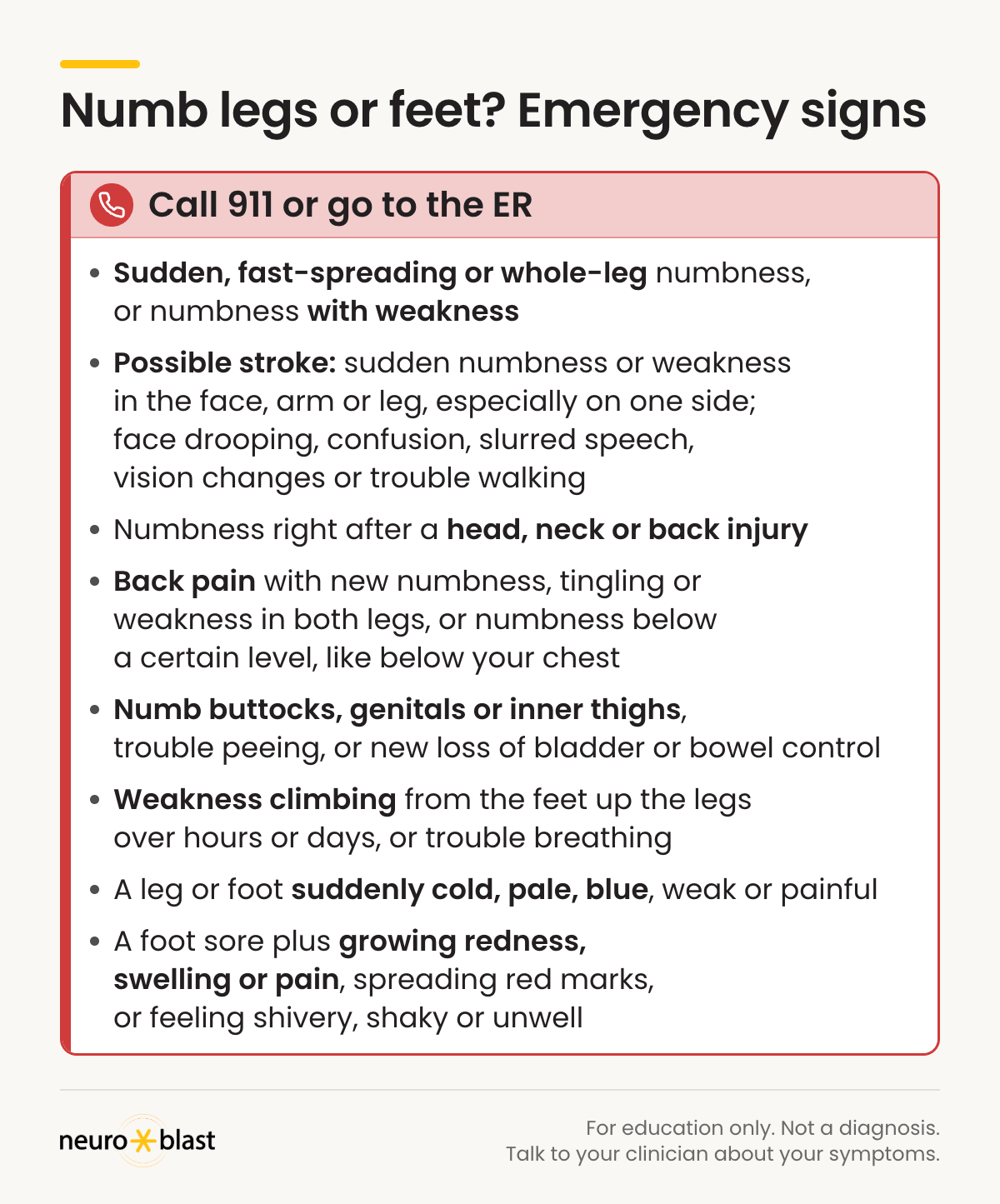
Call 911 or go to the emergency room for:
- Numbness that comes on suddenly, spreads quickly or affects an entire leg.
- Numbness with weakness, or you can't move a leg.
- Sudden numbness or weakness in the face, arm or leg, especially on one side of the body, or face drooping, confusion, slurred speech, vision changes or trouble walking. These can signal a stroke.
- Numbness right after a head, neck or back injury.
- Back pain with new numbness, tingling or weakness in both legs, or numbness below a certain level of your body, such as below your chest. These can signal pressure on the spinal cord or nerve roots.
- Numbness in the "saddle area" (buttocks, genitals and inner thighs), trouble peeing or new loss of bladder or bowel control. This can be cauda equina syndrome, severe pressure on the nerves at the base of the spine that may need emergency surgery.
- Weakness climbing from the feet up the legs over hours or days, or any trouble breathing. Guillain-Barré syndrome can start this way.
- A leg or foot that suddenly turns cold, pale or blue, or suddenly becomes numb, weak or painful. This can mean a clot is blocking blood flow.
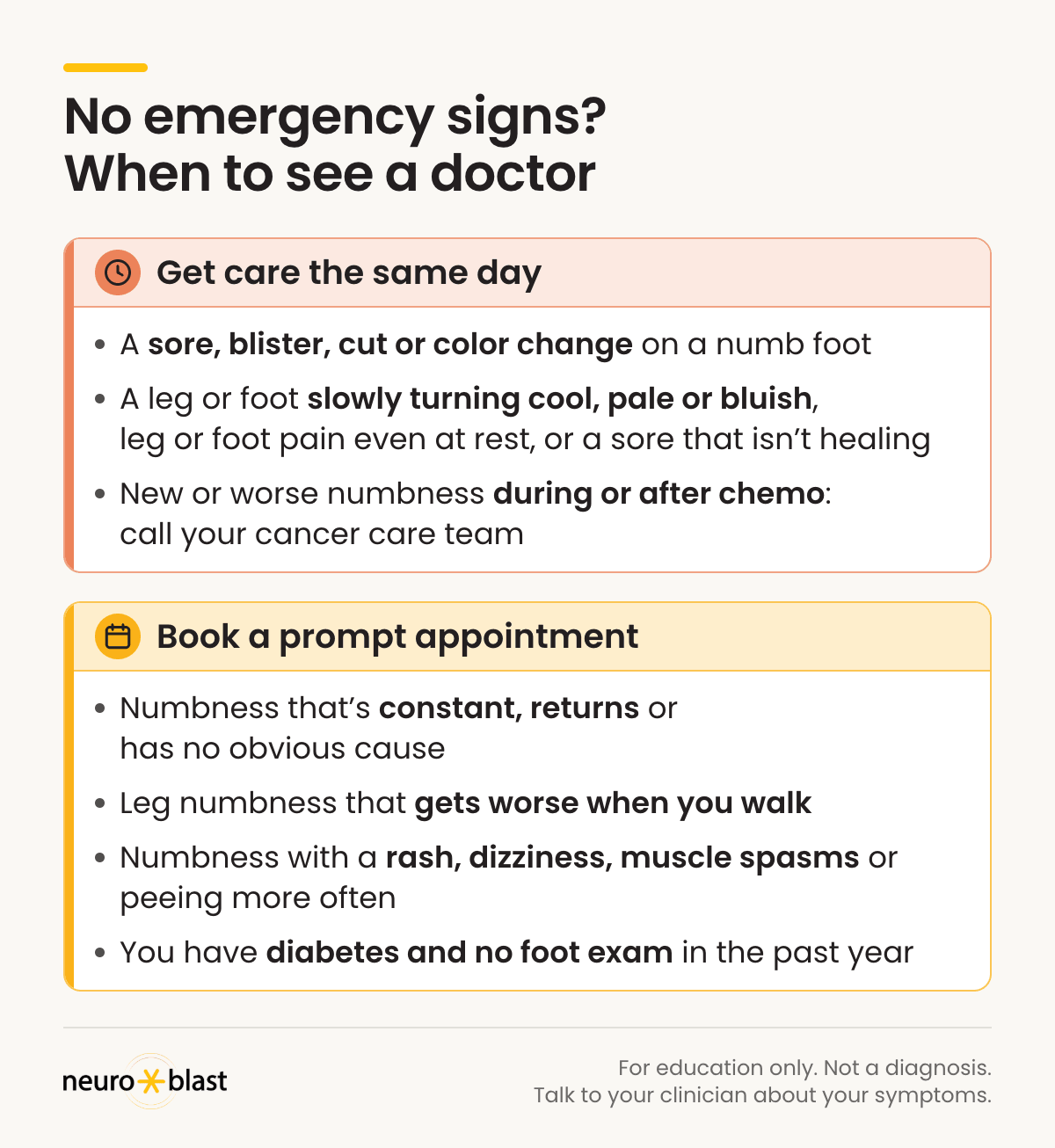
Get care the same day for:
- A sore, blister, cut or color change on a numb foot, especially if you have diabetes. Go to the ER instead if the foot or leg is getting more red, swollen or painful, you see red marks spreading, or you feel shivery, shaky or generally unwell, which can signal a serious infection.
- A leg or foot that has gradually become cool, pale, bluish or numb, leg or foot pain even at rest, or a leg or foot sore that isn't healing.
- New or worsening numbness during or after chemotherapy. Call your oncology team, since treatment can sometimes be adjusted.
Book a prompt appointment if:
- The numbness has no obvious cause, is constant or keeps coming back.
- Numbness in your legs gets worse when you walk.
- It comes with a rash, dizziness, muscle spasms or more frequent urination.
- You have diabetes and haven't had a foot exam in the past year.
Before you treat it: match the pattern to a likely cause
Peripheral neuropathy means damage to nerves outside the brain and spinal cord, and more than 100 types exist. But the spine and blood vessels can also cause numbness in legs, so the pattern is your best first clue. If your hands tingle too, see our guide to tingling in feet and hands.
| Pattern | Possible driver | Other clues | Usual next step |
|---|---|---|---|
| Brief "asleep" feeling after sitting or crossing your legs | Pressure on a nerve | Clear trigger; fades once you move | Move; see a doctor if it keeps recurring |
| Both feet, slowly creeping toward the shins | Peripheral neuropathy, most often from diabetes | Burning, tingling or poor balance; may be painless | Foot and nerve exam; blood sugar, B12 and thyroid tests |
| Both feet after adding or stacking supplements | Too much vitamin B6 | Multivitamins plus B-complex or "energy" products | Label review with your clinician |
| Lower legs or buttocks, worse standing or walking, better sitting or leaning forward | Lumbar spinal stenosis (a narrowed spinal canal in the low back) | Back pain; most common after 60 | Exam, sometimes spine imaging; physical therapy |
| Calf, thigh or foot aching with walking that eases with rest; cool, pale feet | Peripheral artery disease (narrowed leg arteries) | Smoking, diabetes, high cholesterol | Ankle-brachial index test |
| Both feet, starting during or after chemotherapy or a new medicine | Medication-related neuropathy | Cancer, HIV, heart or seizure drugs | Medication review with the prescriber |
Numbness in only one leg has different causes, such as a pinched nerve in the lower back.
Both feet, slowly creeping upward
Most neuropathies affect the longest nerves first, so symptoms usually start in the feet and slowly creep toward the shins. Diabetes is the leading U.S. cause. Up to 50% of diabetic neuropathy may cause no symptoms, so feeling fine doesn't mean your feet are safe. For feet-only symptoms, see symptoms of neuropathy in the feet.
Numbness in lower leg when standing or walking
Spinal stenosis symptoms tend to worsen when you stand or walk and ease when you lean forward or sit. With peripheral artery disease (PAD), aching or fatigue comes on with walking and fades after several minutes of rest, and feet may later feel numb at rest. See these signs of poor circulation in the legs.
Medicines, supplements and alcohol
- Metformin and B12. In a large U.S. study, low-or-borderline B12 was about twice as common after 5 years of metformin as with placebo (19.1% vs. 9.5%). Don't stop metformin; ask about a B12 test.
- Too much vitamin B6. Excess B6, usually from supplements, is a well-known cause of neuropathy. It mainly affects sensation, and symptoms often improve after the source is stopped, though recovery can be slow or incomplete.
- Alcohol. Thiamine deficiency is most common with chronic alcohol use, malnutrition and bariatric surgery. If you drink heavily, talk with a clinician before cutting back, because stopping suddenly can cause withdrawal that may quickly become life-threatening. SAMHSA's National Helpline, 1-800-662-HELP (4357), offers free, confidential treatment referral 24/7 in English and Spanish.
What a doctor or podiatrist will check
Primary care is a sensible first stop, with a neurologist usually involved when initial testing finds no answer.
Exam and quick in-office tests
- 10-gram monofilament test: a thin nylon strand pressed on the foot to check protective sensation, recommended yearly for everyone with diabetes.
- 128-Hz tuning fork: placed on the big toe to test vibration sense.
- Pinprick or temperature sensation and a balance test.
- Foot inspection: skin, foot shape and pulses.
Podiatrists such as Dr. Sharone Stern, DPM, who has more than 30 years in practice focused on peripheral neuropathy and diabetic foot care, commonly pair sensation testing with a check of skin, foot shape and pulses, which together make up the comprehensive foot exam the ADA recommends at least yearly for people with diabetes. Dr. Stern is a co-founder and formulator of Neuro-Blast. The American Podiatric Medical Association advises people with neuropathy to see a podiatrist at least once a year.
Blood tests and nerve tests
- First-line blood tests: complete blood count, metabolic panel, fasting glucose, B12, thyroid (TSH) and serum protein electrophoresis, which looks for abnormal blood proteins.
- Nerve conduction studies and electromyography (EMG): measure how nerves carry signals and muscles respond.
- Spine MRI or CT when stenosis or a disc problem is suspected.
- Ankle-brachial index (ABI): compares blood pressure at the ankle and arm to check for PAD.
Treatment for numbness in feet and legs, by cause
Some neuropathies can be stopped or reversed if diagnosed and treated quickly, though long-standing, severe damage is less likely to reverse. For established neuropathy, the APMA notes there's no known cure, so care focuses on slowing progression, managing pain and protecting the feet.
Blood sugar management
Good glucose management can prevent or delay neuropathy in type 1 diabetes and slow its progression in type 2, and may reduce symptoms.
Correcting vitamin B12 deficiency
Treatment is B12 shots or high-dose oral B12, depending on the cause. Nerve damage may become permanent if treatment isn't started promptly, and recovery can take months or years.
Removing a trigger
For excess B6, the main step is stopping the source with your clinician's guidance. A prescriber may switch an involved medicine, and an oncology team may adjust chemotherapy if neuropathy becomes intolerable.
Taking pressure off the spine and nerves
For spinal stenosis, options include physical therapy with stretching and core strengthening, anti-inflammatory medicines, epidural steroid injections and sometimes surgery. For neuropathy that weakens the foot or ankle muscles, braces and orthopedic shoes can improve walking and help prevent foot injuries. Surgery to relieve nerve pressure helps some people with severe weakness, but most neuropathies involve scattered damage that surgery doesn't help.
Improving circulation
For PAD, the core steps are quitting smoking, walking that alternates activity with rest, foot care and prescribed medicines, with procedures when PAD is severe.
Medicines for nerve pain, and what they can't do
Common options include duloxetine, nortriptyline, gabapentin, pregabalin, lidocaine patches and capsaicin. The American Academy of Neurology notes these drug types reduce pain but may not eliminate it, and guidelines don't present them as a way to bring back lost feeling. The ADA, AAN and NINDS advise against opioids for neuropathic pain.
What the research says about supplements
Supplements are not a treatment for numbness or the conditions behind it. Here's what studies of three common ingredients found.
- Alpha-lipoic acid (ALA): a Cochrane review of three trials (816 people) found it probably has little or no effect on diabetic neuropathy symptoms at six months. ALA may affect blood sugar: it is a rare but increasingly reported trigger of insulin autoimmune syndrome, which causes repeated low blood sugar. Stop ALA and call a clinician if you get signs of low blood sugar such as shakiness, sweating or confusion, and ask your prescriber first if you take diabetes medicines.
- PEA (palmitoylethanolamide) was studied in 11 small trials (774 people) with mixed chronic pain conditions. Pain scores were lower than with placebo and no major side effects were reported, but all but one trial had fewer than 100 people. Evidence is limited, and there's no evidence it restores sensation.
- Acetyl-L-carnitine: evidence for diabetic nerve pain is very low certainty, and ASCO discourages it for preventing chemotherapy-related neuropathy. Clear any supplement with your oncologist.
The NCCIH warns never to replace diabetes treatment with unproven products. For how these and other approaches compare, see our neuropathy treatment options guide.
Daily habits that protect numb feet and legs
- Check both feet daily for cuts, blisters, redness or swelling. A daily foot care checklist helps make it routine.
- Wash in warm, not hot, water and don't soak. Dry well, and moisturize but not between the toes.
- Wear shoes and socks or slippers, even indoors, and check inside shoes first. See this guide to choosing shoes for neuropathy.
- Trim toenails straight across and see a podiatrist regularly if your feet stay numb.
- Keep moving within your limits. A 2025 umbrella review found exercise improved neuropathy symptoms, balance and function in some analyses, with unclear effects on falls and ulcers. See these tips on walking safely with neuropathy.
- Don't smoke, limit alcohol and keep a healthy weight.
Where Neuro-Blast fits
Supplements don't replace diagnosis or treatment of the underlying cause, whether that's blood sugar, a vitamin deficiency, the spine or circulation.
The Neuro-Blast System pairs daily capsules with an oral spray to support healthy nerve function. The capsules are formulated with PEA, alpha-lipoic acid, B vitamins, choline and inositol; the spray with PEA, acetyl-L-carnitine, boswellia and B vitamins. Each two-capsule serving contains 40 mg of vitamin B6. That is below the U.S. adult upper limit of 100 mg a day but above the 10 mg a day from supplements the NHS advises without a doctor's recommendation, so ask your clinician before starting, count the B6 in everything you take, and stop and call your clinician if new numbness or tingling begins. Check with your oncologist during chemotherapy and your prescriber if you take diabetes medicines. The Neuro-Blast oral spray is also sold on its own; it carries its own label, and the 40 mg above is the capsule amount.
These statements have not been evaluated by the Food and Drug Administration. This product is not intended to diagnose, treat, cure, or prevent any disease.
Frequently asked questions
Is numbness in both legs and feet an emergency?
It is if it starts suddenly or climbs quickly, or comes with weakness, confusion, trouble breathing, saddle-area numbness, trouble peeing or loss of bladder or bowel control. Call 911. Gradual numbness still needs a prompt visit.
How do I get rid of numbness in my legs and feet?
If pressure caused it, stand up and move; the feeling usually returns soon. Lasting or returning numbness is managed by treating its cause: blood sugar, low B12, excess B6, spinal pressure or circulation. Some causes improve over months, but long-standing nerve damage is less likely to reverse, so see a clinician early.
What is the best treatment for numbness in feet?
There's no single best treatment; it depends on the cause. Blood sugar control, B12 replacement, stopping a supplement trigger, a prescriber-guided medicine change, physical therapy for spinal stenosis and PAD care each target a different cause. Daily foot checks and well-fitting shoes help in every case.
How long does numbness in legs and feet take to go away?
Numbness from pressure usually fades soon after you move. When a cause such as low B12 or a supplement is corrected, feeling can improve over months, and B12-related recovery can take months or years. Long-standing nerve damage is less likely to reverse, so get checked early.
What kind of doctor should I see for numbness in my feet and legs?
Start with primary care for first-line blood tests. A podiatrist checks foot sensation, skin and footwear. A neurologist helps when the cause is unclear; vascular or spine specialists handle circulation or stenosis.
This article is for general education and is not a substitute for personalized medical advice. Talk with your healthcare provider about your symptoms and before starting any supplement.
