

Numbness in one leg is unsettling, especially with no clear reason. Where it's numb, what makes it worse and what comes with it usually point to the cause and to how urgent it is.
This guide sorts those clues and flags the warning signs that can't wait.
Numbness in one leg is most often caused by a pinched nerve: a compressed nerve root in the lower back (sciatica), pressure on the peroneal nerve beside the knee, or a squeezed outer-thigh nerve. Circulation problems and stroke are less common. Sudden numbness or weakness needs a 911 call.
Call 911 now for sudden numbness or weakness in a leg, numbness in the groin with new bladder or bowel problems, or a leg that suddenly turns cold, pale and painful.
What causes numbness in one leg? Start with where it's numb
One-sided numbness usually follows a single nerve, so location is your best first clue. It's a guide, not a diagnosis.
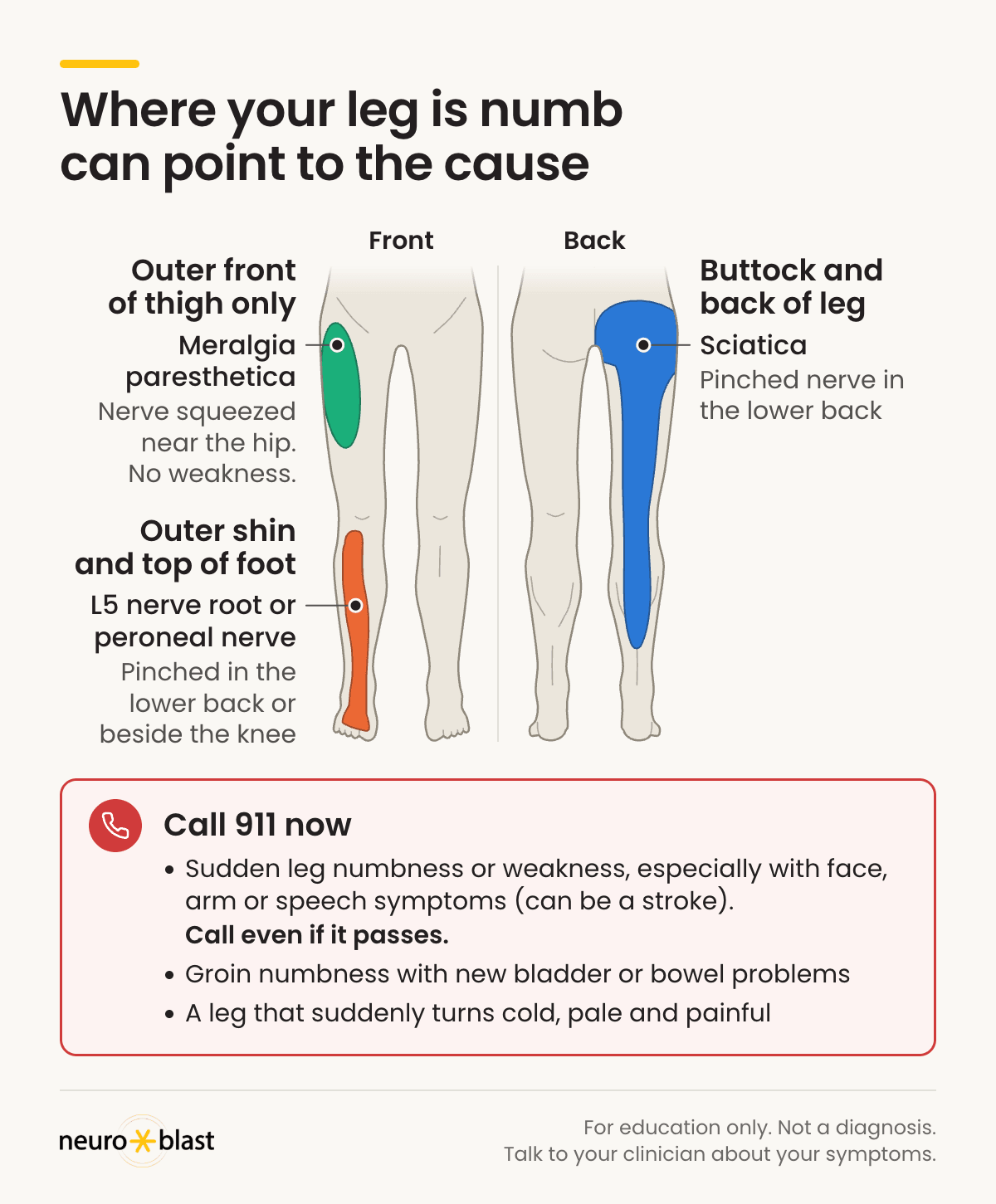
| Where it's numb | Often points to | Other clues |
|---|---|---|
| Buttock and back of the leg | Sciatica | Shooting pain; worse with coughing or bending |
| Outer shin and top of the foot | L5 nerve root or peroneal nerve | Toes catch when walking |
| Outer ankle and outer foot | S1 nerve root | Weaker push-off on tiptoe |
| Inner ankle and inner foot | L4 nerve root | Weaker knee straightening |
| Outer front of the thigh only | Meralgia paresthetica | Burning patch, no weakness |
| Deep buttock, worse sitting | Piriformis syndrome | Sciatica-like tingling |
| Legs numb or heavy when walking | Lumbar spinal stenosis | Eases when you lean forward or sit |
| Calf cramping when walking | Peripheral artery disease (PAD) | Eases when you stop; one foot colder |
| Thigh or hip, with severe pain | Diabetic amyotrophy | Diabetes; weakness and weight loss follow |
| Whole leg, suddenly | Stroke or TIA, or a blocked leg artery | Face, arm or speech symptoms (stroke); cold, pale, painful leg (artery). Call 911 for either. |
| Groin, genitals or inner thighs, with bladder or bowel changes | Cauda equina syndrome | Call 911 |
If both feet are numb in a symmetrical pattern, the likely causes are different; see our overview of common neuropathy symptom patterns.
Pinched nerve in the lower back (sciatica)
Radiculopathy means a nerve root is irritated where it leaves the spine, often by a herniated disc or age-related narrowing. When the roots forming the sciatic nerve are involved, it's called sciatica.
Sciatica usually affects one leg at a time, and many cases improve within four to six weeks without medical treatment. Back pain, if present, is usually milder than the leg symptoms.
L4, L5 and S1: how the nerve roots differ
| Root | Numb area | May weaken | Reflex that may fade |
|---|---|---|---|
| L4 | Inner ankle and foot | Straightening the knee | Knee-jerk |
| L5 | Top of the foot | Lifting the foot and big toe | Inner hamstring |
| S1 | Outer ankle and foot | Pushing off (calf) | Ankle-jerk |
Spinal stenosis: numbness that builds as you walk
Lumbar spinal stenosis is a narrowing of the spinal canal. Leg pain, numbness or cramping typically worsens with standing or walking and improves with leaning forward or sitting.
Piriformis syndrome
The piriformis muscle sits deep in the buttock beside the sciatic nerve. Irritation there can mimic sciatica and often worsens with long sitting. It's diagnosed only after other causes are ruled out.
Numbness in the left or right leg below the knee: the peroneal nerve
The common peroneal (fibular) nerve wraps around the outer knee just under the skin. Peroneal neuropathy is the most common compressive nerve problem of the leg. It can cause numbness on the top of the foot or the outer part of the leg.
It can also cause foot drop, weakness lifting the front of the foot. Your toes scrape the ground and you lift your knee higher to clear them. Our guide to the peroneal nerve and lower-leg movement explains the anatomy.
Leg crossing, casts, kneeling and rapid weight loss
Common triggers include habitual leg crossing, long bed rest, tight casts, prolonged kneeling or squatting, and a very thin build.
In a 2026 case series, two men who lost 30 to 50 pounds on tirzepatide and habitually crossed their legs developed foot drop over 24 to 72 hours. Both recovered within about four months of no longer crossing their legs; one also used physical therapy and a brace. Two cases can't show how common this is, but if you're losing weight quickly, avoid crossing your legs. Don't stop a weight-loss medicine without talking with your prescriber.
Peroneal nerve or L5? How doctors tell foot drop apart
A pinched L5 root and a compressed peroneal nerve can both cause foot drop. Hip strength helps tell them apart: weakness moving the leg out to the side (hip abduction) appeared in 85.7% of people with L5 radiculopathy but only 3.6% with peroneal palsy, according to research cited in that case series. Back pain also points toward the spine.
Stroke can occasionally start as foot drop. Call 911 if foot drop comes on suddenly or with face or arm weakness, speech trouble or vision changes. Foot drop that developed over hours to days still needs same-day care.
Outer thigh numbness: meralgia paresthetica
Meralgia paresthetica happens when the nerve carrying feeling from the outer front of the thigh is squeezed near the hip bone, causing numbness, burning or pain in that patch. The nerve has no muscle fibers, so it doesn't cause weakness. Tight belts or clothing, obesity, pregnancy and diabetes raise the risk, and about 85% of people recover with conservative care.
Circulation causes: PAD, blocked arteries and blood clots
Poor blood flow can also starve leg nerves.
PAD or spinal stenosis? Notice what eases it
Peripheral artery disease (PAD) narrows the arteries feeding the legs, causing pain, heaviness or cramping with walking. One foot may feel colder, and leg weakness or numbness can affect balance.
PAD pain is usually relieved by rest with no need to change position, while stenosis tends to ease only when you sit or bend forward. Our article on signs of poor circulation in the legs lists other clues.
Blood clots: artery or vein?
A clot that suddenly blocks a leg artery makes the leg painful, pale, cold and numb. This acute limb ischemia is a vascular emergency.
A clot in a deep leg vein (deep vein thrombosis, or DVT) rarely causes numbness. CDC lists swelling, pain or tenderness, warmth, and redness or discoloration. A very large vein clot can swell the leg enough to choke off arterial blood flow, causing numbness and weakness, a rare emergency.
Brain and spinal cord causes: stroke, TIA and MS
A classic stroke warning sign is sudden numbness or weakness in the face, arm or leg, especially on one side. Call 911 and note when symptoms started.
A transient ischemic attack (TIA), or "warning stroke," blocks blood flow briefly, usually for no more than five minutes. Symptoms fade, but as many as 10% to 15% of people have a major stroke within three months. Symptoms that went away still need a 911 call.
In multiple sclerosis (MS), the immune system attacks the protective coating on nerves in the brain and spinal cord, which can cause numbness or tingling in the arms, legs, trunk or face.
Diabetic amyotrophy: one-sided thigh pain and weakness
Most diabetes-related nerve damage starts in both feet. Diabetic amyotrophy affects about 1% of people with diabetes, mostly older adults with type 2. It usually begins on one side with severe thigh, hip or buttock pain, followed by weakness, muscle wasting and weight loss. It can stay active for up to two years. Most people gradually improve, though some weakness can remain.
Numbness in the left leg vs the right leg: does the side matter?
Many people worry that numbness in the left leg signals a heart problem. Leg numbness isn't among the CDC's listed heart attack symptoms, and numbness in the right leg isn't automatically safer. The side matters mainly for stroke: damage on one side of the brain causes weakness on the opposite side of the body.
How doctors find the cause
- Neurological exam: sensation, strength (including hip abduction), reflexes and a straight-leg raise.
- MRI: recent, uncomplicated radiculopathy doesn't usually need imaging right away unless red flags appear. MRI is the preferred test if symptoms last one to two months.
- EMG and nerve conduction studies: tests of electrical activity in muscles and nerves that help separate a root problem from a peroneal one.
- Vascular tests: the ankle-brachial index (ABI) compares ankle and arm blood pressure; a resting ABI below 0.90 suggests PAD. Doppler ultrasound checks blood flow.
Treatment depends on the cause
| Cause | Common first steps |
|---|---|
| Sciatica | Staying active, heat, physical therapy; injection or surgery for selected cases |
| Peroneal nerve compression | No leg crossing, knee padding, a brace and physical therapy; surgery if these fail |
| Meralgia paresthetica | Looser belts and clothing, weight management |
| Piriformis syndrome | Stretching, physical therapy, breaks from sitting |
| Spinal stenosis | Physical therapy, activity changes; surgery for some |
| PAD, MS, diabetic amyotrophy | Specialist-led care |
When to see a doctor for leg weakness and numbness
Match your symptoms to one of three levels.
Call 911 (don't drive yourself)
- Sudden numbness or weakness in the leg, arm or face, especially on one side; sudden confusion, trouble speaking or seeing, dizziness, loss of balance or trouble walking; or a sudden severe headache. Call even if symptoms passed.
- Numbness in the groin, genitals or around the anus; new trouble peeing or controlling your bowels; or severe or worsening weakness in both legs. These can signal cauda equina syndrome, compression of the nerve bundle at the base of the spine, which needs immediate medical attention; prompt surgery gives the best chance of protecting bladder, bowel and leg function.
- A leg that suddenly turns painful, pale or bluish, cold and numb.
- A very swollen, discolored leg that goes numb, or leg swelling with chest pain or trouble breathing.
- Numbness with rapid or sudden weakness, numbness that affects an entire leg or spreads quickly, or numbness below a certain level of your body, such as below the chest.
Get care today
- Foot drop or leg weakness that developed or worsened over hours or days. Call 911 instead if it came on suddenly or with other stroke signs.
- One leg that's swollen, warm, red or tender.
- Go to an emergency department for numbness or weakness with back pain plus fever, unexplained weight loss, cancer history, IV drug use, a weakened immune system or long-term steroid use. These can signal a spinal infection or cancer in the spine.
- Diabetes plus new, severe one-sided thigh pain.
- A cast or splint that makes your leg feel tight or numb: call your provider right away. Go to the emergency room if pain under it keeps rising despite pain medicine and raising the leg, or your toes turn pale or won't move. These can signal compartment syndrome.
- A blister, cut or sore on a numb foot, or signs of infection such as redness, warmth or pain, especially if you have diabetes.
Book an appointment
- Sciatica that hasn't improved after a few weeks of home care or is getting worse.
- Numbness with no clear cause, slow loss of strength, walking cramps or a numb outer thigh.
Everyday steps that can help
- Uncross your legs and limit long kneeling or squatting.
- Loosen belts and waistbands if your outer thigh is numb.
- Keep moving with sciatica. Stay active, try heat packs and avoid long sitting or lying down.
- Lower your fall risk. Foot drop makes falls more likely, so clear walkways, add lighting, wear any prescribed brace and see our fall prevention and home safety tips.
- Rebuild strength and balance once your clinician clears you, starting with these gentle balance and leg-strength exercises.
Where Neuro-Blast fits
A numb leg has a cause worth finding, and the steps above are aimed at that. A supplement is not one of them: supplements don't diagnose or treat the cause, and they don't replace medical care.
Neuro-Blast capsules are formulated with PEA, alpha-lipoic acid and B vitamins to support healthy nerve function, and the Neuro-Blast System pairs those capsules with an oral spray. The spray's B vitamins are thiamine (B1) and B12; its label lists no B6. Each two-capsule serving contains 40 mg of vitamin B6, below the U.S. adult upper limit of 100 mg a day but above the 10 mg a day from supplements the NHS advises without a doctor's recommendation, so ask your clinician before starting, count the B6 in everything you take, and stop and call your clinician if numbness or tingling spreads, or starts somewhere new such as both feet or your hands. Alpha-lipoic acid can lower blood sugar, so check with your prescriber first if you take diabetes medicines.
These statements have not been evaluated by the Food and Drug Administration. This product is not intended to diagnose, treat, cure, or prevent any disease.
Frequently asked questions
When should I worry about leg numbness?
Call 911 if numbness or weakness comes on suddenly, or comes with speech trouble, groin numbness, new bladder or bowel changes, or a cold, pale leg. Get same-day care for foot drop that developed over hours or days, or for a swollen leg. Book a visit if numbness lingers or keeps returning.
Is numbness in one leg a sign of a stroke?
It can be. Sudden numbness, especially with weakness, face or arm symptoms, or trouble speaking, needs a 911 call. Numbness that builds slowly or changes with position is far more often a pinched nerve.
Can a blood clot cause numbness in the leg?
A clot in a leg vein (DVT) rarely causes numbness; its usual signs are swelling, pain, warmth and redness. A clot that blocks a leg artery is different: it causes sudden pain, numbness and a pale or cold leg, so call 911. Call 911, too, if a leg swells badly and goes numb or weak.
Does numbness in the left leg mean a heart problem?
Leg numbness isn't among the CDC's listed heart attack symptoms, and neither leg is safer. What matters is how fast it starts: sudden numbness or weakness on one side can be a stroke.
Why does my leg go numb when I sit or cross my legs?
Crossing your legs presses on the peroneal nerve beside the knee, and long sitting can irritate the sciatic nerve. Numbness that fades within minutes of moving is common; numbness that keeps returning, or a foot that stays weak, needs a check.
This article is for general education and is not a substitute for personalized medical advice. Talk with your healthcare provider about your symptoms and before starting any supplement.
