

Numbness in toes is common, and the pattern usually tells you the most: which toes, one foot or both, and what sets it off.
Sudden numbness with one-sided weakness, a drooping face or trouble speaking can be signs of a stroke. Call 911 or your local emergency number now.
Numbness in toes most often comes from pressure on a nerve (tight shoes, laces or high heels), cold-triggered spasm of small blood vessels, or peripheral neuropathy, which usually starts in both feet. Numbness that clears once your shoes come off points to fit; constant, spreading or diabetes-linked numbness needs an exam.
Numbness vs. tingling in toes
Numbness means reduced or lost feeling; you might not notice a pebble in your shoe. Tingling in toes is pins and needles (paresthesia), and many people feel both. See our guide to tingling in the feet and hands.
Why are my toes numb? Causes of numb toes by pattern
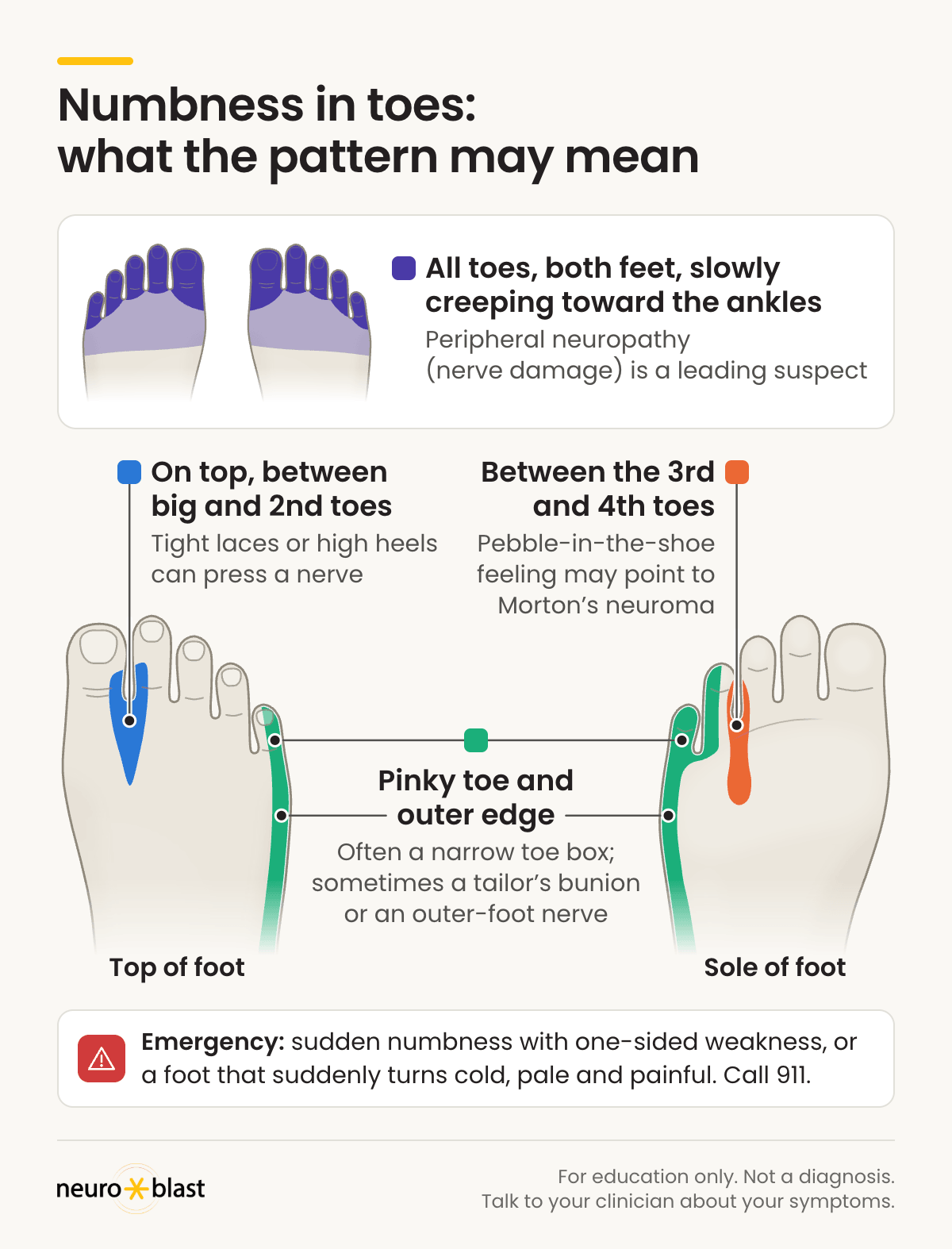
All toes on both feet: neuropathy is a leading suspect
When the toes on both feet go numb and the feeling slowly creeps toward the ankles, think of peripheral neuropathy (damage to nerves outside the brain and spinal cord). Most neuropathies are "length-dependent": the longest nerves, ending in the toes, show symptoms first.
Diabetes is the leading U.S. cause of peripheral neuropathy, and up to half of people with diabetes have it. Other causes include low vitamin B12, heavy alcohol use, chemotherapy, some medicines and excess vitamin B6. Read more about neuropathy symptoms in the feet and how diabetic neuropathy develops.
One or two toes: often local pressure
Numbness in one or two toes more often points to pressure on one nerve branch: a narrow or shallow toe box (the front of the shoe), tight laces or a recent bump or sprain. A 2025 review of nerve entrapment names tight laces and high heels as causes of deep peroneal nerve compression, which affects the top of the foot and the first web space.
Numbness between the third and fourth toes with a pebble-in-the-shoe feeling may be a Morton's neuroma (a thickened forefoot nerve), which tight shoes and heels aggravate.
Big-toe numbness has its own causes, such as bunions and tight shoes. Book an exam if it lasts; get same-day care if lifting the big toe or foot suddenly feels weak, a possible L5 nerve root sign.
Pinky toe numb: toe box, bunionette or an outer-foot nerve
The sural nerve supplies the outer edge of the foot and the fifth toe; the lateral plantar nerve supplies the underside of the fifth toe and the outer half of the fourth. Usual suspects:
- A narrow or pointed toe box that squeezes the little toe.
- Tailor's bunion (bunionette). A bony bump at the little toe's base, worsened by narrow shoes. It mainly causes pain and corns but may irritate nearby small nerves.
- Sural nerve irritation. It affects the outer ankle and foot, is more common in runners and after repeated ankle sprains, and can be worsened by tight footwear.
- A low-back nerve root. Less often, an irritated S1 nerve root causes numbness along the sole or outer edge of the foot, usually with back pain.
Toes numb after wearing heels
In a pressure-mapping study of 27 young women, high heels put the most pressure under the ball of the foot behind the big and second toes. Heels also keep the ankle pointed, which can compress the deep peroneal nerve, and many squeeze the toes.
The American Podiatric Medical Association advises avoiding heels higher than two inches. If feeling returns once they're off, the shoes are the likely trigger. If numbness lingers or shows up in other shoes, book an exam.
Toes that go numb during exercise
Feet swell on long walks and runs, so shoes can pinch later, and tight laces press on nerves across the top of the foot. Loosen them or skip the eyelets over the sore spot.
Leg pain, tightness or cramping that starts during exercise and fades when you stop, sometimes with foot numbness, can be chronic exertional compartment syndrome (pressure building inside a muscle group), which is usually not an emergency. Calf cramping when walking that eases with rest, a colder foot or bluish skin can point to peripheral artery disease (PAD), a narrowing of leg arteries. Read about blood flow to the feet.
Numb toes in the cold: Raynaud's, chilblains or frostbite
Cold numbs anyone's toes; Raynaud's, chilblains and frostbite go further.
| Raynaud's | Chilblains | Frostbite | |
|---|---|---|---|
| What you notice | Toes turn white, then blue and numb, then red as blood returns | Itchy or burning red-purple swellings | Numb skin that looks white or grayish-yellow and feels firm or waxy |
| Timing | During cold or stress; a typical attack lasts about 20 minutes | A few hours after cold exposure; often clear in 2 to 3 weeks | After exposure to freezing temperatures |
| What to do | Warm your whole body; avoid tobacco and caffeine | Warm up slowly; no radiators or hot water; don't scratch | Go to the emergency room. Rewarm in warm, not hot, water; no heating pads or other direct heat; don't rub or walk on the toes. Call 911 for hypothermia signs (shivering, confusion, drowsiness) |
Simple checks you can do at home
- Shoe checks. If you can't spread your toes while standing in your shoes, the toe box is too tight. Pressure numbness generally eases once shoes come off; if it doesn't, fit isn't the whole story.
- Ipswich Touch Test. Close your eyes while a partner lightly touches the tips of your big, third and little toes on each foot for 1 to 2 seconds; missing two or more of the six spots suggests reduced sensation. Done at home by relatives, it caught about 78 of every 100 people with reduced feeling on clinic testing and correctly cleared about 94 of every 100 without it. It was studied in people with diabetes and is only a screen; lasting symptoms still need an exam.
- Daily look. Check tops, soles and between toes for cuts, blisters or color change.
What a podiatrist checks
Expect questions about triggers, diabetes, alcohol, medicines and supplements. The American Diabetes Association also lists B12 deficiency (especially with long-term metformin) and low thyroid as causes to rule out.
Podiatrists such as Dr. Sharone Stern, DPM, who has more than 30 years in practice focused on peripheral neuropathy and diabetic foot care, commonly perform a comprehensive foot exam that includes the elements the ADA Standards of Care recommend. Dr. Stern is a co-founder and formulator of Neuro-Blast.
- Skin and foot shape: corns, calluses, bunions and hammertoes.
- 10-gram monofilament: a thin nylon strand that tests protective sensation.
- 128-Hz tuning fork: vibration sense at the big toe.
- Pinprick or temperature: small nerve fibers.
- Pulses: blood flow.
- Tinel's sign (not part of the ADA screen; used when entrapment is suspected): tapping over a nerve to see if it tingles.
If neuropathy is suspected, blood tests, nerve conduction studies or electromyography (EMG) may follow.
When to see a doctor about numb toes
Call 911 or your local emergency number
- Sudden numbness or weakness in the face, arm or leg, especially on one side, or sudden trouble speaking, seeing or walking (possible stroke).
- A foot or toes that suddenly turn cold, pale or blue and painful, especially with trouble moving them (possible acute limb ischemia; permanent damage can occur within four to six hours).
- Severe, worsening leg or foot pain with tightness, swelling or numbness after an injury, or under a cast or splint (possible acute compartment syndrome).
- Numbness in the saddle area (inner thighs, buttocks and genitals) or new loss of bladder or bowel control (possible cauda equina syndrome), or numbness that spreads quickly.
- Weakness that starts in the feet and climbs the legs over hours to days, or any trouble breathing (possible Guillain-Barré syndrome).
- Toes that are hard, waxy, white or grayish-yellow, blistered or turning dark after cold exposure (possible frostbite).
Get same-day care
- A cut, blister, slow-healing sore or sign of infection on a numb foot, especially with diabetes; reduced feeling lets injuries go unnoticed, and the lifetime risk of a foot ulcer in diabetes is 19% to 34%.
- Toes turning dark or black, toe or foot sores that won't heal, or foot pain at rest (possible critical limb ischemia from severe PAD).
- Toes that stay white, blue or numb for hours, or don't recover after rewarming.
- New weakness lifting your foot or big toe, or a foot that slaps or catches as you walk (possible nerve root compression).
Book an appointment
- Numbness in both feet that is constant, keeps coming back or is slowly spreading.
- Calf cramping when you walk that eases with rest, or one foot colder or paler than the other (possible PAD).
- New toe numbness if you have diabetes or take metformin or long-term heartburn medicines, which are linked to low B12. Keep taking your medicines unless your prescriber says otherwise.
- If you're having chemotherapy, tell your oncology team about new numbness before your next treatment.
- Raynaud's attacks that affect only one side or cause sores.
With diabetes, get a foot exam at least yearly even without symptoms; up to 50% of diabetic neuropathy may cause none.
How to treat numb toes by cause
Treatment follows the cause. For medical options, see this guide to care options for neuropathy in the feet.
| Likely cause | First steps | If that isn't enough |
|---|---|---|
| Tight shoes, laces or heels | Wider, deeper toe box; heels two inches or lower; looser lacing | An exam if numbness persists |
| Nerve entrapment | Remove the pressure; physical therapy; orthotics | Corticosteroid injections; surgical release |
| Raynaud's | Keep warm; manage stress; avoid tobacco and caffeine | Prescription calcium channel blockers |
| Diabetic neuropathy | Blood sugar management; daily foot checks; yearly foot exam | Prescription medicines for nerve pain; therapeutic shoes |
| Low vitamin B12 | Blood test to confirm | If low: B12 by injection or mouth, started promptly to limit lasting nerve damage |
| Chemotherapy-related | Tell your oncologist early | Dose changes; duloxetine for painful neuropathy |
Supplement safety points to know
Supplements don't treat the causes of numb toes, and some can cause nerve problems of their own.
- Ask about a B12 blood test, especially if you take metformin.
- More B6 is not better. Too much vitamin B6 can itself cause numbness and tingling. A 2026 Health Canada safety review found a possible link even at 10 mg a day or more. Add up B6 across your products, and if new numbness or tingling starts while you take B6, stop it and tell your clinician.
- Avoid acetyl-L-carnitine during chemotherapy. In a trial of 409 women with breast cancer on taxane chemotherapy, 3,000 mg a day for 24 weeks led to worse neuropathy than placebo over two years of follow-up. ASCO guidance discourages it.
- Alpha-lipoic acid has mixed evidence and can lower blood sugar. NCCIH calls the diabetic neuropathy findings inconsistent, and Memorial Sloan Kettering notes it can lower blood sugar, so ask your prescriber first if you take insulin or other diabetes medicines.
Footwear and foot-care tips for numb toes
- Choose a roomy toe box; skip narrow, pointed styles.
- If feeling is reduced, never go barefoot, even at home, and check shoes for pebbles.
- Wash feet in warm, not hot, water, and skip heating pads and hot-water bottles on numb feet; reduced feeling makes burns easy to miss.
See our guides to choosing shoes for neuropathy and daily foot care with neuropathy.
Where Neuro-Blast fits
Supplements don't diagnose or treat the cause of numb toes, and they don't replace medical care. The Neuro-Blast System pairs capsules formulated with PEA, alpha-lipoic acid, B vitamins, choline and inositol with an oral spray formulated with PEA, acetyl-L-carnitine, boswellia and B vitamins, to support healthy nerve function. Some people prefer to start with a single product; the Neuro-Blast capsules are sold by themselves. Each two-capsule serving contains 40 mg of vitamin B6. That is below the U.S. adult upper limit of 100 mg a day but above the 10 mg a day from supplements the NHS advises without a doctor's recommendation, so, as the supplement safety points above explain, ask your clinician before starting, count it with any other B6 you take, and stop and call your clinician if new numbness or tingling begins. Because the spray contains acetyl-L-carnitine, don't use it during chemotherapy unless your oncologist approves.
These statements have not been evaluated by the Food and Drug Administration. This product is not intended to diagnose, treat, cure, or prevent any disease.
Frequently asked questions
When should I be worried about numbness in my toes?
Call 911 for sudden one-sided numbness or weakness, facial droop or speech trouble; a suddenly cold, pale, painful foot; weakness climbing from the feet or trouble breathing; or saddle numbness with bladder or bowel changes. Get same-day care for a sore or infection on a numb foot, or toes turning dark. Book a visit if numbness is constant, spreading or keeps returning.
Why is my pinky toe numb?
A narrow toe box pressing on the little toe is common. A tailor's bunion, sural nerve irritation or, less often, a low-back nerve root can also be involved; see a podiatrist if roomier shoes don't help.
Why do my toes go numb after wearing heels?
Heels load the ball of the foot, squeeze the toes and keep the ankle pointed, which can compress nerves on top of the foot.
Is numbness in toes a sign of diabetes?
It can be. Diabetes is the leading U.S. cause of peripheral neuropathy, which often starts in the toes of both feet. Other causes are common, so testing is needed.
Can tight shoes cause permanent toe numbness?
Brief numbness from tight shoes usually clears once the pressure is gone. Numbness that lingers for days after you switch to roomier shoes, or keeps returning, can mean an irritated nerve and needs an exam.
This article is for general education and isn't a substitute for personalized medical advice. Talk with your healthcare provider about your symptoms and before starting any supplement.
