

Your feet burn at night, the bedsheet hurts your toes, and yet your nerve conduction study came back normal. That is a classic pattern of small fiber neuropathy, nerve damage that standard nerve tests aren't designed to detect.
Here's how it's confirmed, what causes it and how it's treated.
Small fiber neuropathy damages the thin nerves that sense pain and temperature and help control sweating and heart rate. It usually causes burning, tingling or prickling pain that starts in both feet. Standard nerve conduction tests are often normal, so doctors confirm it with a skin punch biopsy.
What is small fiber neuropathy?
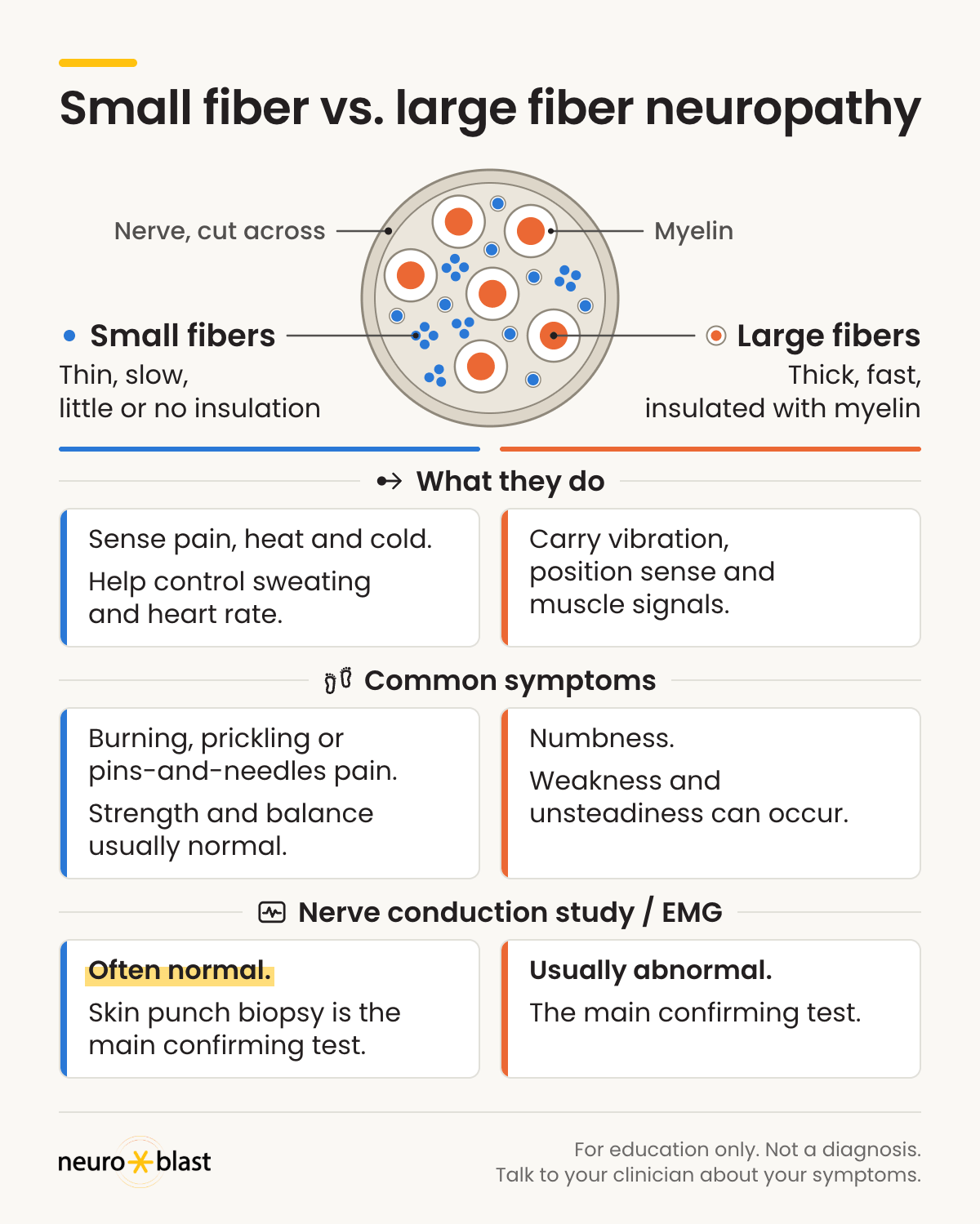
Large nerve fibers are thick, insulated with myelin, and carry vibration, position sense and muscle signals. Small fibers are thinly insulated A-delta fibers and uninsulated C fibers. Small fiber neuropathy (SFN) means these thin fibers are damaged.
Small fibers detect pain, heat, cold and itch. They also help regulate heart rate, blood pressure, body temperature, digestion and bladder function, the job of the autonomic nervous system.
Small fiber vs. large fiber neuropathy
| Feature | Small fiber neuropathy | Large fiber neuropathy |
|---|---|---|
| Main sensations | Burning, prickling or electric pain; reduced hot and cold feeling | Numbness; reduced vibration and position sense |
| Strength and balance | Usually normal | Weakness and unsteadiness can occur |
| Nerve conduction study / EMG | Often normal | Usually abnormal |
| Main confirming test | Skin punch biopsy, autonomic testing | Nerve conduction study / EMG |
How common is it?
A Minnesota study that counted only test-confirmed cases found about 13 per 100,000 people. Patients averaged 54 at onset, and 51% had diabetes.
Small fiber neuropathy symptoms
The symptoms of small fiber neuropathy are sensory (what you feel) or autonomic (automatic body functions). New to the terms? Start with what neuropathic pain means.
Sensory symptoms
- Burning pain or pins and needles, often beginning in the feet
- Pain from touch that shouldn't hurt, such as socks or bedsheets, called allodynia
- A feeling of walking on sand, pebbles or golf balls
- Itching, numb patches, or trouble sensing hot and cold
- Pain that is often worst at night
Length-dependent and non-length-dependent patterns
Most people have a length-dependent pattern: the longest nerves go first, so symptoms begin in both feet. A less common non-length-dependent pattern is patchy and can involve the face, trunk or arms. Its cause is usually never found, though doctors check for immune conditions such as Sjögren's and, less often, cancer-related (paraneoplastic) causes.
Autonomic symptoms of small fiber neuropathy
Autonomic involvement occurs in nearly half of patients. Signs include:
- Sweating too much or too little, or heat intolerance
- Lightheadedness or fainting when you stand, and palpitations
- Dry eyes or dry mouth, stomach cramps, and bowel or bladder changes (sudden loss of control is an emergency)
Why your EMG or nerve conduction study can be normal
A nerve conduction study measures signals in large, fast, insulated fibers. Small fibers are too thin and slow to register: A-delta fibers conduct at 4 to 36 meters per second and C fibers at just 0.4 to 2.8.
So the test is normal when only small fibers are involved, though it still checks for large fiber damage. SFN can also be mistaken for fibromyalgia.
How small fiber neuropathy is diagnosed
Symptoms alone aren't reliable. In a 2019 study in Brain, 19 of 34 people with symptoms but a normal exam and normal tests had recovered at 18 months, so doctors also look for abnormal findings.
Small fiber neuropathy skin biopsy
- What happens: a 3-millimeter circle of skin is removed from the lower leg near the ankle, sometimes with a second sample from the thigh.
- What the lab measures: nerve fibers reaching the top skin layer, called intraepidermal nerve fiber density (IENFD), compared with age-matched norms. It confirms fiber loss but not the cause.
- Safety: in about 35,000 biopsies, minor side effects occurred in 0.19% and none were serious.
- Accuracy: sensitivity is about 88%, but in one study of people with recently diagnosed type 2 diabetes and diabetic polyneuropathy, it detected only 51% of cases. A normal biopsy doesn't completely rule SFN out.
Autonomic testing and corneal confocal microscopy
The quantitative sudomotor axon reflex test (QSART) measures how well small nerves trigger sweating, with sensitivity up to 80%. Corneal confocal microscopy, a painless scan of nerves in the eye, is promising. But among 214 people with recently diagnosed type 2 diabetes and neuropathy, it detected just 14.4%.
Blood tests to look for a cause
First tests often include A1c and a glucose tolerance test, B12, thyroid function, celiac antibodies, an autoimmune screen (ANA), and HIV and hepatitis C. Later tests may check copper, B6 and thiamine, look for abnormal blood proteins that can point to amyloidosis, and screen for cancer-related antibodies.
Small fiber neuropathy causes
No cause is found in about half of cases, or 70% in the Minnesota study, so ask about repeat testing over time. Identified causes fall into these groups.
| Category | Examples |
|---|---|
| Blood sugar | Diabetes, prediabetes and impaired glucose tolerance, metabolic syndrome |
| Vitamins and hormones | Low B12, underactive thyroid, copper deficiency, too little or too much B6 |
| Autoimmune | Sjögren's syndrome, celiac disease, sarcoidosis, lupus |
| Infections | HIV, hepatitis C, Lyme disease, long COVID |
| Medicines and toxins | Some chemotherapy drugs (oxaliplatin, bortezomib, docetaxel), metronidazole, nitrofurantoin, alcohol |
| Blood and cancer-related | AL amyloidosis and other abnormal blood proteins (monoclonal gammopathy), paraneoplastic syndromes |
| Inherited | Sodium-channel gene variants, Fabry disease, hereditary transthyretin amyloidosis |
Blood sugar problems, including prediabetes
A normal A1c doesn't settle the question. Among 107 people with unexplained neuropathy, 34% had impaired glucose tolerance and the 2-hour oral glucose tolerance test was the most sensitive screen. More on diabetic neuropathy basics.
Vitamin and thyroid problems
Metformin and stomach-acid reducers may lower B12 levels. Don't stop these medicines on your own; ask your doctor whether a B12 test makes sense. Vitamin B6 cuts both ways: long-term high doses can cause sensory neuropathy on their own.
Autoimmune conditions, including celiac disease
Among 13 people with SFN and gluten sensitivity, 10 of 11 who had an intestinal biopsy showed celiac changes. The authors recommend celiac screening in unexplained SFN. Get tested before going gluten-free, which can make celiac tests unreliable.
Genetic causes
A 2019 study of 1,139 people with pure SFN found likely disease-causing variants in three sodium-channel genes combined in 11.6%.
Small fiber neuropathy treatment
Treat the underlying cause first
For diabetes or prediabetes, treatment means blood sugar control, exercise and weight loss. In the Look AHEAD study of overweight adults with type 2 diabetes, intensive lifestyle change was linked to lower neuropathy pain scores. Other steps include replacing low B12, treating thyroid disease, a gluten-free diet for confirmed celiac disease, and specialist care for immune conditions (see our neuropathy treatment options guide).
Nerve pain medicines a doctor may prescribe
Most drug evidence covers neuropathic pain generally, not SFN. A 2025 analysis of 313 trials supports three first-line classes: tricyclic antidepressants (such as amitriptyline), gabapentin or pregabalin, and SNRIs (such as duloxetine), with lidocaine and capsaicin as second-line options. Benefits are modest.
Neurologists advise against opioids for painful diabetic neuropathy. These medicines can cause drowsiness or dizziness.
What about IVIG?
In a trial of 60 people with unexplained SFN, pain improved in 40% on IVIG (an antibody infusion from donated blood) versus 30% on placebo, a difference that wasn't statistically significant. It isn't a proven SFN treatment, though specialists may consider it in selected immune-related cases.
What research says about supplements
No supplement is proven to treat small fiber neuropathy. None of the studies below were done in people with SFN, and the evidence is limited.
- Alpha-lipoic acid: was studied in 10 trials (1,242 people with diabetic neuropathy, 600 to 1,800 mg a day). Symptom scores improved, but pain ratings and nerve conduction did not. A 2024 Cochrane review of three trials (816 people) found it probably makes little or no difference to diabetic neuropathy symptoms at six months. It can lower blood sugar and may interfere with chemotherapy and radiation.
- Acetyl-L-carnitine: a Cochrane review of 4 trials (907 people with diabetic neuropathy) found a small pain reduction in 3 placebo-controlled trials, only at doses above 1,500 mg a day, but the authors are very uncertain the effect is real. ASCO discourages it for preventing chemotherapy neuropathy.
- PEA (palmitoylethanolamide): was studied in 11 trials of 774 people with various chronic pain conditions, which reported lower pain scores. The best dose is unclear.
- B vitamins: B12 is replaced when a blood test confirms a deficiency. With B6, more isn't better: the US adult upper limit is 100 mg a day, and Europe's is 12 mg.
Outlook: does small fiber neuropathy go away?
In the Minnesota study, most patients had symptoms without significant disability, and 36% developed large fiber involvement, on average 5.3 years after onset. In a two-year cohort, 13% did, and more than half of patients improved or stayed stable.
Symptoms can worsen, then plateau for years, and some people improve once a treatable cause is found. Fast worsening is uncommon and in the Minnesota study occurred mainly with amyloidosis, Fabry disease, uncontrolled diabetes or Lewy body disease, so tell your doctor if symptoms spread quickly.
SFN itself is not usually life-threatening. But in the Minnesota study, people with SFN had more heart attacks and a higher death rate than people without it, half of them from diabetes complications. That's why treating the underlying cause matters.
When to see a doctor
Most small fiber neuropathy symptoms build slowly. These signs need faster care.
Call 911 or go to the emergency room
- Sudden numbness or weakness of the face, arm or leg, especially on one side, or sudden confusion or trouble speaking, which are stroke signs
- Weakness or tingling spreading up from the feet over hours or days, or trouble breathing, which can signal Guillain-Barré syndrome
- Sudden loss of bladder or bowel control, or numbness in the saddle area (buttocks and inner thighs), especially with back pain or new leg weakness, which can signal cauda equina syndrome
- Fainting if you are over 50, have diabetes, were injured, don't come to within a couple of minutes, or have chest pain, a pounding or irregular heartbeat, or trouble speaking, seeing or moving a limb
- Foot skin or a wound that turns black or smells bad, a possible sign of gangrene
Get same-day care
- Any other first-time or repeated fainting, even if you feel fine afterward
- A foot cut, blister or sore that is red, warm, swollen or not healing, or a callus with dried blood inside it, especially if you have diabetes or reduced feeling in your feet
- New muscle weakness or repeated falls, which pure SFN doesn't usually cause
Book a prompt appointment
- New burning, tingling or pain in your hands or feet
- Symptoms spreading to new areas, worsening flares, or new trouble walking
- New tingling while taking vitamin B6 supplements, or during or after chemotherapy
Living with small fiber neuropathy: practical tips
- Protect your sleep. In the Minnesota study, 86% of people with SFN had insomnia. Keep bedding loose over your feet, and see our tips on sleeping with neuropathy.
- Check your feet daily and wear shoes and socks at all times. See our daily foot care checklist.
- Be careful with heat. Test bath water with your elbow or a thermometer and keep it at 90 to 95°F. Skip heating pads on your feet, since burns are a known complication.
- Stand up slowly if you get lightheaded, and tell your doctor.
- Review supplements with your doctor. Bring every bottle so your doctor can check your total B6 and interactions. For background, see our alpha-lipoic acid overview.
Where Neuro-Blast fits
Supplements don't diagnose or treat the cause of small fiber neuropathy, and they don't replace testing, a diagnosis, treatment of the underlying cause such as blood sugar or a vitamin level, or any care your clinician prescribes. Neuro-Blast capsules are a dietary supplement formulated with PEA, alpha-lipoic acid and B vitamins to support healthy nerve function. The same capsules are paired with an oral spray in the Neuro-Blast System. None of the research above was done on Neuro-Blast. Alpha-lipoic acid can lower blood sugar. Review the Supplement Facts label on whichever you choose with your doctor first, especially if you take diabetes medicines. Each two-capsule serving contains 40 mg of vitamin B6: below the U.S. adult upper limit of 100 mg a day but above Europe's 12 mg limit cited above, so ask your doctor whether it's right for you, count the B6 in everything you take, and stop and call your doctor if new numbness or tingling begins. The oral spray carries its own label; the 40 mg above is the capsule amount. If you're having chemotherapy or radiation, ask your oncologist before taking any supplement. The spray contains acetyl-L-carnitine, so don't use it during chemotherapy unless your oncologist approves.
These statements have not been evaluated by the Food and Drug Administration. This product is not intended to diagnose, treat, cure, or prevent any disease.
Frequently asked questions
What are the first signs of small fiber neuropathy?
The first signs are usually burning, prickling or pins-and-needles pain in both feet, often worse at night. Socks or bedsheets may hurt, and hot and cold can be hard to sense. Sweating changes or lightheadedness on standing can also occur.
What is the most common cause of small fiber neuropathy?
Diabetes and prediabetes are the most common identified causes. Others include low B12, thyroid disease, celiac disease, Sjögren's syndrome, some medicines and alcohol. In about half of cases, no cause is found.
Is small fiber neuropathy an autoimmune disease?
Sometimes. Sjögren's syndrome, celiac disease, lupus and sarcoidosis are recognized causes, and doctors screen for them with blood tests. Blood sugar problems are more common, and many cases have no identified cause.
Is small fiber neuropathy progressive?
It can be, but usually slowly, and symptoms may plateau for years. Studies report that 13% to 36% of people develop large fiber involvement. Fast worsening is uncommon and should prompt a check for rarer causes such as amyloidosis.
Can you die from small fiber neuropathy?
Small fiber neuropathy itself is not usually life-threatening, but some causes, such as diabetes and amyloidosis, can be serious. A Minnesota study found more heart attacks and deaths in people with SFN than in controls, half due to diabetes complications. That's a link, not proof that SFN causes death, and it's why a thorough workup matters.
This article is for general education and is not a substitute for personalized medical advice. Talk with your healthcare provider about your symptoms and before starting any supplement.
