

Is your big toe numb, or does it feel oddly padded while the rest of your foot seems normal? Usually the cause is local and mechanical: a narrow shoe, tight laces, or a bunion pressing on one of the toe's small nerves.
Safety first: call 911 if numbness comes on suddenly with one-sided weakness, facial droop or trouble speaking, or if your foot suddenly turns cold, pale or blue.
Big toe numb? Most often, something is pressing on one of the toe's small nerves: tight or narrow shoes, snug laces, a bunion or a bone spur on the big toe joint. Less common causes include a pinched L5 nerve root, early peripheral neuropathy, poor circulation, cold exposure and recent toe surgery. Sudden numbness with weakness elsewhere needs emergency care.
Numbness in the big toe only: what the location tells you
Several nerves supply the big toe (the hallux), each covering its own patch of skin, so the numb spot is a clue. If other parts of your foot hurt, see this guide to foot pain by location.
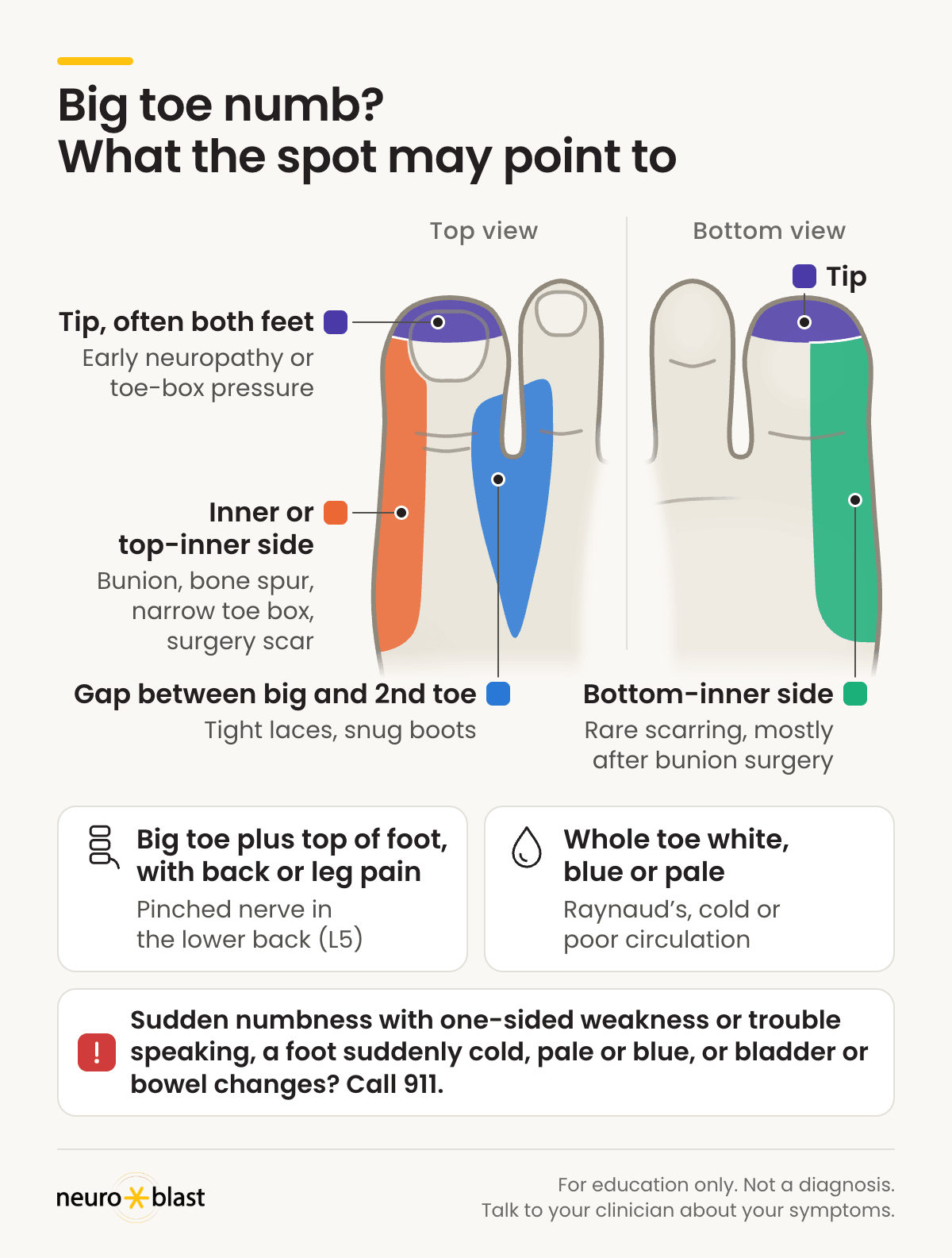
| Numb area | Nerve usually involved | Common causes to consider |
|---|---|---|
| Inner side or top-inner side | Dorsomedial cutaneous nerve | Bunion, bone spur, narrow toe box, surgical scar |
| Bottom-inner side | Medial plantar digital nerve | Scarring after bunion surgery; less often, inner-arch nerve compression in runners |
| Top of the foot into the gap next to the big toe | Deep peroneal nerve | Tight laces, snug boots, sprinting or dancing |
| Big toe plus top of the foot, with back or leg pain | L5 nerve root | Herniated disc or narrowing in the lower spine |
| Tip of the toe, often both feet | Nerve endings farthest from the spine | Early peripheral neuropathy, toe-box pressure |
| Whole toe, white, blue or pale | Blood vessels, not nerves | Raynaud's, frostnip, poor circulation |
Tip of big toe numb: shoe pressure or early neuropathy?
Most neuropathies (damage to nerves outside the brain and spinal cord) affect the longest nerves first, so symptoms usually begin in the feet. If both tips are numb or it spreads to other toes, ask about a neuropathy check; this guide to neuropathy symptom patterns shows what to look for. One numb tip after a long run, hike or new shoes more likely reflects toe-box pressure.
Big toe is numb on one side: inner edge vs. underside
Inner-edge numbness usually involves the dorsomedial cutaneous nerve, which supplies the top-inner big toe right where bunions and spurs form. Bottom-inner numbness points to the medial plantar digital nerve; rare scarring of it, called Joplin's neuroma, most often follows bunion surgery.
Why is my big toe numb? Common causes
Tight shoes and lacing pressure
A narrow toe box squeezes the toe's nerves. Tight laces, boots or athletic gear can compress the deep peroneal nerve on top of the foot, which supplies the web space between the big and second toes. Footwear and lacing changes are first-line care. See this overview of the peroneal nerve.
Bunions (hallux valgus)
A bunion is a bony bump at the base of the big toe, affecting about 23% of adults aged 18 to 65 and 36% of those over 65. It can cause numbness, tingling and burning along the top-inner side of the joint.
The numbness can go unnoticed. In one small study of 43 people with bunions, 21% reported sensory symptoms, but testing found measurable sensory loss in another 44%.
Stiff big toe (hallux rigidus)
Hallux rigidus is arthritis that stiffens the big toe joint, usually between ages 30 and 60. A bone spur on top of the joint can press on a nerve, numbing the inner border of the toe.
Injury or recent toe surgery
A crushed toe can bruise skin nerves, and surgery can stretch or cut them. Most nerve symptoms fade, but some numbness can be permanent.
A pinched nerve in the lower back (L5)
The L5 nerve root supplies the top of the foot and the first three toes. A disc or narrowed spinal canal can pinch it (radiculopathy); when pain runs down the leg, it's called sciatica. Weakness lifting the big toe is a clue. Most radiculopathy cases improve without surgery, and sciatica usually improves within weeks to months.
Early peripheral or diabetic neuropathy
Diabetes is the leading cause of peripheral neuropathy in the U.S., and up to half of people with diabetes have it. It usually affects both feet gradually. Other causes include vitamin B12 deficiency, long-term heavy alcohol use and chemotherapy.
Poor circulation (peripheral artery disease)
Narrowed leg arteries can make the feet feel numb at rest and cool or pale, often with leg cramps when walking. In severe cases, toes can turn dark or blue and develop sores that don't heal.
Cold exposure and Raynaud's
In Raynaud's phenomenon, toe blood vessels narrow with cold or stress, turning the skin white, then blue, cold and numb. Frostbite starts with pins and needles, then numbness.
Running and sports
Runners can develop medial plantar nerve compression along the inner arch, which typically causes arch pain. Sprinting, soccer and dancing, which flex the ankle sharply upward, are linked with deep peroneal nerve irritation.
When to see a doctor about a numb big toe
Call 911 or go to the emergency room
- Sudden numbness or weakness in the face, arm or leg, especially on one side, or trouble speaking, seeing or walking (possible stroke).
- A foot or leg that suddenly turns cold, pale or blue, or becomes painful, numb or weak (possible blocked artery). Don't wait to check a pulse.
- Numbness around the genitals or buttocks, new loss of bladder or bowel control, symptoms in both legs, or rapidly worsening leg weakness (possible cauda equina syndrome).
- After a crush injury: numbness with severe or worsening swelling, pain far worse than expected or unrelieved by pain medicine, or a pale or deformed toe (possible compartment syndrome or fracture).
- Possible frostbite: skin that is hard and pale, blistered, or turning dark.
- A foot wound with fever or chills, redness that spreads quickly, or skin turning black (possible serious infection or tissue damage).
Get care the same day
- You have diabetes or reduced foot feeling and notice a wound, blister, redness, swelling or drainage. Neuropathy was a component cause in 78% of diabetic foot ulcers.
- Mild cold injury where normal feeling and color don't return promptly after rewarming.
- New trouble lifting the big toe or front of the foot, so your toe catches or your foot slaps.
Book a prompt appointment
- Numbness that lasts beyond a few days in roomier shoes, keeps returning or has no clear cause.
- Numbness spreading to other toes or both feet.
- Numbness after surgery that is burning, worsening or not improving.
- A foot that is often cool, pale or bluish, leg cramps when walking, or toe sores that are slow to heal.
What a podiatric exam involves
Podiatrists such as Dr. Sharone Stern, DPM, who has more than 30 years in practice focused on peripheral neuropathy and diabetic foot care, commonly check foot sensation with a 10-gram monofilament and a 128-Hz tuning fork, tools named in diabetes foot-screening guidelines. Dr. Stern is a co-founder and formulator of Neuro-Blast.
A visit for a numb big toe may include these steps:
- History: the exact spot, one or both feet, onset, shoes, back pain, diabetes, medicines and surgery.
- Shoe and skin check: toe box width, lace marks, bunions, spurs, skin color and wounds.
- Sensation tests: the monofilament (a thin nylon strand pressed on the skin) and a tuning fork against the big toe, compared with the other foot.
- Tinel's sign: tapping over a nerve to see if it tingles, a sign of irritation.
- Joint, circulation and strength: big toe motion, foot pulses, and strength lifting the big toe and ankle.
- Tests if needed: X-rays; blood tests (A1c, B12, thyroid); nerve conduction studies or EMG; a lower-spine MRI if a pinched nerve root is suspected.
Treatment depends on the cause
| Cause | Usual first steps | If symptoms persist |
|---|---|---|
| Shoe or lace pressure | Wider, deeper toe box; skip eyelets over the sore spot | Exam for a spur or trapped nerve |
| Bunion | Wide toe box, padding, ice, custom orthotics | Surgery if pain limits daily life; numbness is a known risk |
| Stiff big toe | Roomy toe box, stiff or rocker-bottom sole | Injection, spur-removal surgery or joint fusion |
| L5 radiculopathy | Staying active, physical therapy | Injection; surgery for lasting symptoms or worsening weakness |
| Peripheral neuropathy | Treat the cause, manage blood sugar, daily foot checks | Prescription medicines if painful |
What should I do if my big toe is numb?
- Take the pressure off. Loosen laces or skip tight shoes for a few days.
- Map the pattern. Note the spot, one foot or both, and what shoes or activity came first.
- Rewarm gently. For cold, numb toes, use warm, not hot, water (104 to 108°F), checked with a thermometer or a hand with normal feeling, never the numb foot. Don't rub them, use a heating pad or rewarm if they could refreeze.
- Change your shoes. Choose a wide, deep toe box; this shoe buying guide for sensitive feet covers fit.
- Check your feet daily if you have diabetes or reduced feeling. A daily foot care checklist helps.
A note on supplement safety
- More vitamin B6 isn't better: too much B6 from supplements can itself cause numbness and tingling. Older reports tied this mainly to high doses, but a 2026 Health Canada safety review found a possible link at 10 mg a day or more, and the NHS advises no more than 10 mg a day from supplements unless a doctor recommends more. Count the B6 in all your supplements, including multivitamins.
- Alpha-lipoic acid may affect blood sugar, so check with your clinician first if you take insulin or other diabetes medicines.
- During chemotherapy, get your oncologist's approval before any supplement. ASCO discourages acetyl-L-carnitine, found in some nerve-health supplements, for preventing chemotherapy-related neuropathy, so check labels.
- Don't stop or change a prescribed medicine without your prescriber's advice.
Where Neuro-Blast fits
Finding what is pressing on the nerve is the job of an exam, not a supplement. A supplement doesn't diagnose or treat the cause of a numb big toe, and it doesn't replace medical care. Neuro-Blast capsules are a dietary supplement formulated to support healthy nerve function, with PEA, alpha-lipoic acid, B vitamins, choline and inositol; the oral spray is formulated with PEA, acetyl-L-carnitine, boswellia and B vitamins. In the capsules, each two-capsule serving contains 40 mg of vitamin B6. That is below the U.S. adult upper limit of 100 mg a day but above the 10 mg a day from supplements the NHS advises without a doctor's recommendation, so ask your clinician before starting, count the B6 in everything else you take, such as a multivitamin or B-complex (the oral spray's label lists B1 and B12, not B6), and stop and call your clinician if new numbness or tingling begins. Check with your oncology team during cancer treatment, and with your prescriber if you take diabetes medicine. Review the ingredients on the Neuro-Blast Capsules page, or see the capsules and the oral spray paired together as the Neuro-Blast System.
These statements have not been evaluated by the Food and Drug Administration. This product is not intended to diagnose, treat, cure, or prevent any disease.
Frequently asked questions
Should I be worried if my big toe is numb?
Often not; many cases stem from shoe pressure, a bunion or a stiff joint. Get emergency care for sudden numbness with one-sided weakness or speech trouble, a cold, pale foot, or bladder or bowel changes. Book a visit if it lasts beyond a few days in roomier shoes, spreads, or you have diabetes.
Can tight shoes cause a numb big toe?
Yes. A narrow toe box presses on the toe's nerves, and tight laces or boots can compress the deep peroneal nerve. If numbness persists after a few days in roomier shoes, get checked.
Why does my big toe feel numb but not hurt?
Painless numbness often means steady pressure on a small skin nerve from a narrow toe box, snug laces or a bunion. It can also be an early sign of neuropathy, so get checked if it lasts or spreads to other toes or the other foot.
Can a pinched nerve in my back cause big toe numbness?
Yes. The L5 nerve root supplies the top of the foot and the first three toes; back or leg pain is a clue. Most cases improve over weeks to months without surgery; get checked promptly if weakness develops or numbness isn't improving.
How long does big toe numbness last after bunion surgery?
There's no fixed timeline. Numbness near the incision often improves over months but can be permanent. Tell your surgeon if numbness is burning, worsening or not improving.
This article is for general education and is not a substitute for personalized medical advice. Talk with your healthcare provider about your symptoms and before starting any supplement.
